%20--%3e%3csvg%20version='1.1'%20id='Layer_1'%20xmlns='http://www.w3.org/2000/svg'%20xmlns:xlink='http://www.w3.org/1999/xlink'%20x='0px'%20y='0px'%20viewBox='0%200%20288%2036.3'%20style='enable-background:new%200%200%20288%2036.3;'%20xml:space='preserve'%3e%3cstyle%20type='text/css'%3e%20.st0{fill:%2349C6BB;}%20%3c/style%3e%3cg%3e%3cpath%20class='st0'%20d='M41.2,0h-5.5c-0.7,0-1.2,0.3-1.5,0.9l-12.9,21L8.4,0.9C8,0.3,7.5,0,6.8,0H1.3C0.5,0,0,0.5,0,1.3V35%20c0,0.8,0.5,1.3,1.3,1.3h4.5c0.8,0,1.3-0.5,1.3-1.3V11.5l11.2,17.8c0.4,0.6,0.9,0.9,1.5,0.9h2.9c0.7,0,1.2-0.3,1.5-0.9l11.2-17.9V35%20c0,0.8,0.5,1.3,1.3,1.3h4.5c0.8,0,1.3-0.5,1.3-1.3V1.3C42.5,0.5,42,0,41.2,0z'/%3e%3cpath%20class='st0'%20d='M136.7,0h-29.4c-0.8,0-1.3,0.5-1.3,1.3v4.3c0,0.8,0.5,1.3,1.3,1.3h11.1V35c0,0.8,0.5,1.3,1.3,1.3h4.6%20c0.8,0,1.3-0.5,1.3-1.3V6.9h11.1c0.8,0,1.3-0.5,1.3-1.3V1.3C137.9,0.5,137.5,0,136.7,0z'/%3e%3cpath%20class='st0'%20d='M181.8,0h-29.4c-0.8,0-1.3,0.5-1.3,1.3v4.3c0,0.8,0.5,1.3,1.3,1.3h11.1V35c0,0.8,0.5,1.3,1.3,1.3h4.6%20c0.8,0,1.3-0.5,1.3-1.3V6.9h11.1c0.8,0,1.3-0.5,1.3-1.3V1.3C183,0.5,182.6,0,181.8,0z'/%3e%3cpath%20class='st0'%20d='M233.5,0h-4.6c-0.8,0-1.3,0.5-1.3,1.3v22.8c0,4.4-1.5,5.4-5,5.4H211c-3.4,0-5-1-5-5.4V1.3%20c0-0.8-0.5-1.3-1.3-1.3h-4.6c-0.8,0-1.3,0.5-1.3,1.3v22.5c0,7.7,3.7,12.5,12.2,12.5h11.6c8.5,0,12.2-4.8,12.2-12.5V1.3%20C234.8,0.5,234.3,0,233.5,0z'/%3e%3cpath%20class='st0'%20d='M288,13.9v-0.8C288,4.4,284,0,273.5,0h-18.7c-0.8,0-1.3,0.5-1.3,1.3V35c0,0.8,0.5,1.3,1.3,1.3h4.6%20c0.8,0,1.3-0.5,1.3-1.3v-4.8v-3.4V20v-7.4V6.8h12.2c5.6,0,7.9,1,7.9,6.3v0.7c0,5.2-2.4,6.2-7.9,6.2h-9.1v6.8h9.5l5.6,8.7%20c0.4,0.6,0.9,0.8,1.5,0.8h5.3c1,0,1.4-0.7,0.8-1.5l-6.1-8.7C286,24.4,288,20.2,288,13.9z'/%3e%3cpath%20class='st0'%20d='M81.6,0.9C81.3,0.3,80.9,0,80.1,0h-5.4c-0.7,0-1.2,0.3-1.5,0.9L56.8,34.8c-0.4,0.9,0,1.5,1,1.5H63%20c0.7,0,1.2-0.4,1.5-1l1.3-2.8l5.3-11.6l0,0l6.3-13.5l7.7,16.7h-12L70.4,30h17.4l2.4,5.3c0.3,0.7,0.8,1,1.5,1h5.2c1,0,1.4-0.6,1-1.5%20L81.6,0.9z'/%3e%3c/g%3e%3c/svg%3e) Defense
Defense One platform. Every mission.
American-built.
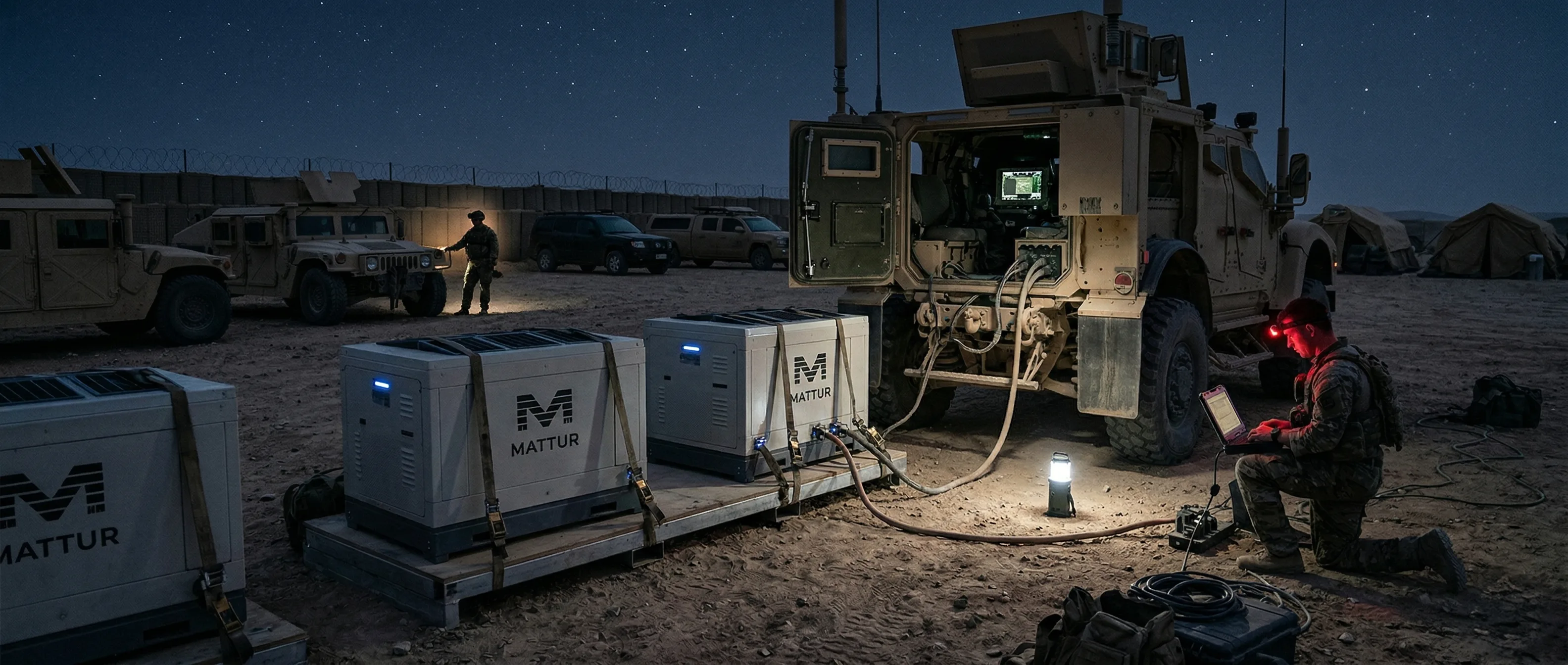
The modern operating model is distributed, autonomous, and always-on. Power generation needs to be too.
Designed for steady loads. Fielded on mixed, transient demand.
Most platforms have a power problem, not an energy problem. Peak demand is brief, average consumption is stable. Legacy generation was built around the wrong assumption.
Transient loads legacy systems can't track
Autonomous systems and persistent surveillance draw power in sharp, unpredictable spikes. Mechanically governed engines can't respond fast enough, producing voltage droop and instability when reliability matters most.
Chronic inefficiency from peak-load sizing
Conventional gensets run at 20–50% load most of their lives. Persistent underloading causes wet-stacking — unburned fuel accumulating in the exhaust — requiring frequent rebuilds. The inefficiency is structural, not incidental.
A fixed acoustic and thermal profile
Fixed-RPM operation produces a predictable output signature. For platforms where signature management is a requirement, that's a constraint built into the power source.
Battery-hybrid complexity without the resilience
Lithium buffers transient loads but adds thermal management, cycle degradation, and logistical dependencies that compound over time. It addresses the symptom, not the underlying architectural mismatch.
Operating concept
Enabling Electrification at the Edge
Electrified, autonomous platforms need power that goes where they go, runs as long as they run, and requires minimal intervention. Mattur is built for that role.
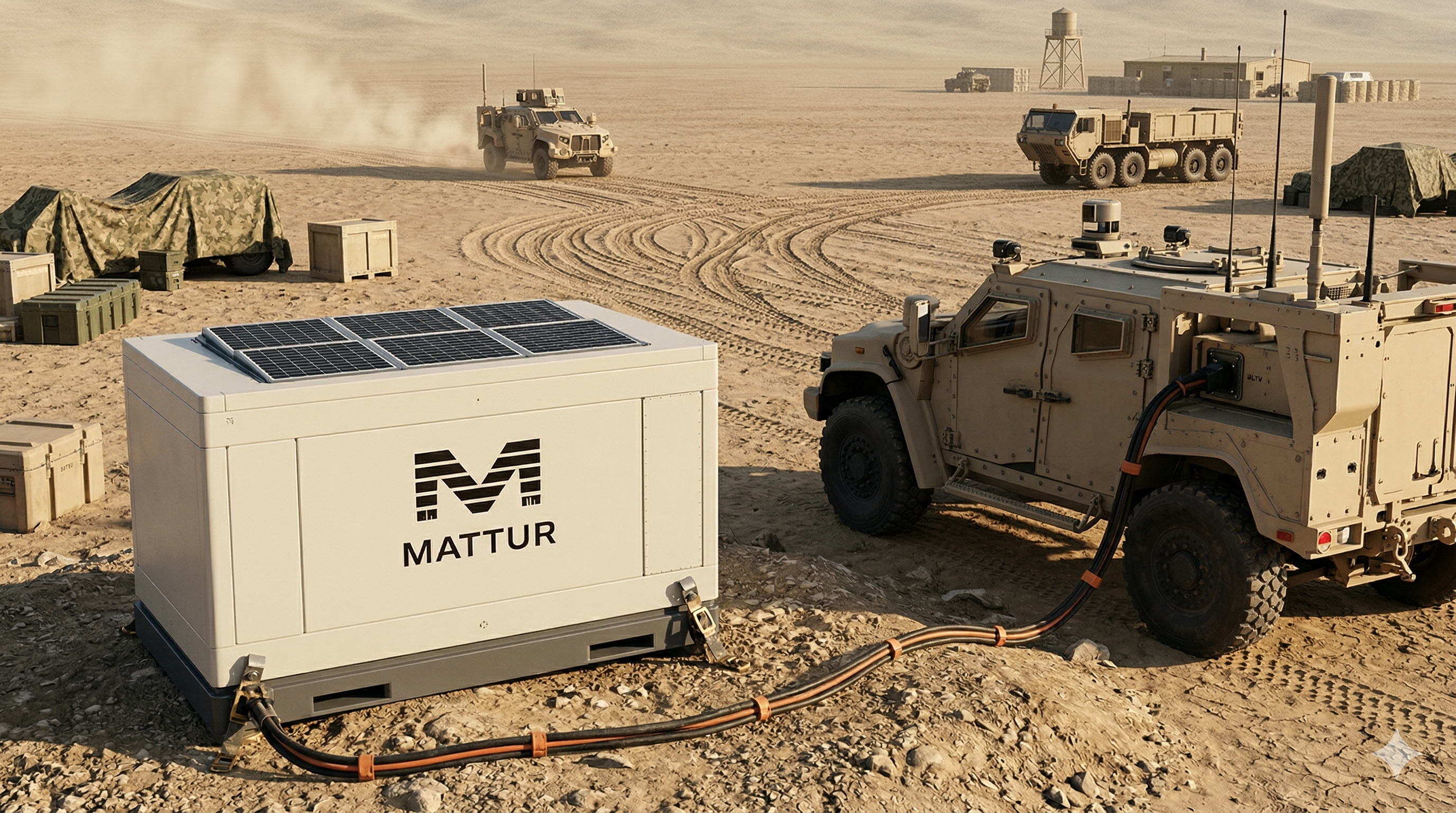
Autonomous ground vehicles
Vehicle-transportable, fuel-flexible, and designed for continuous operation without scheduled maintenance windows.
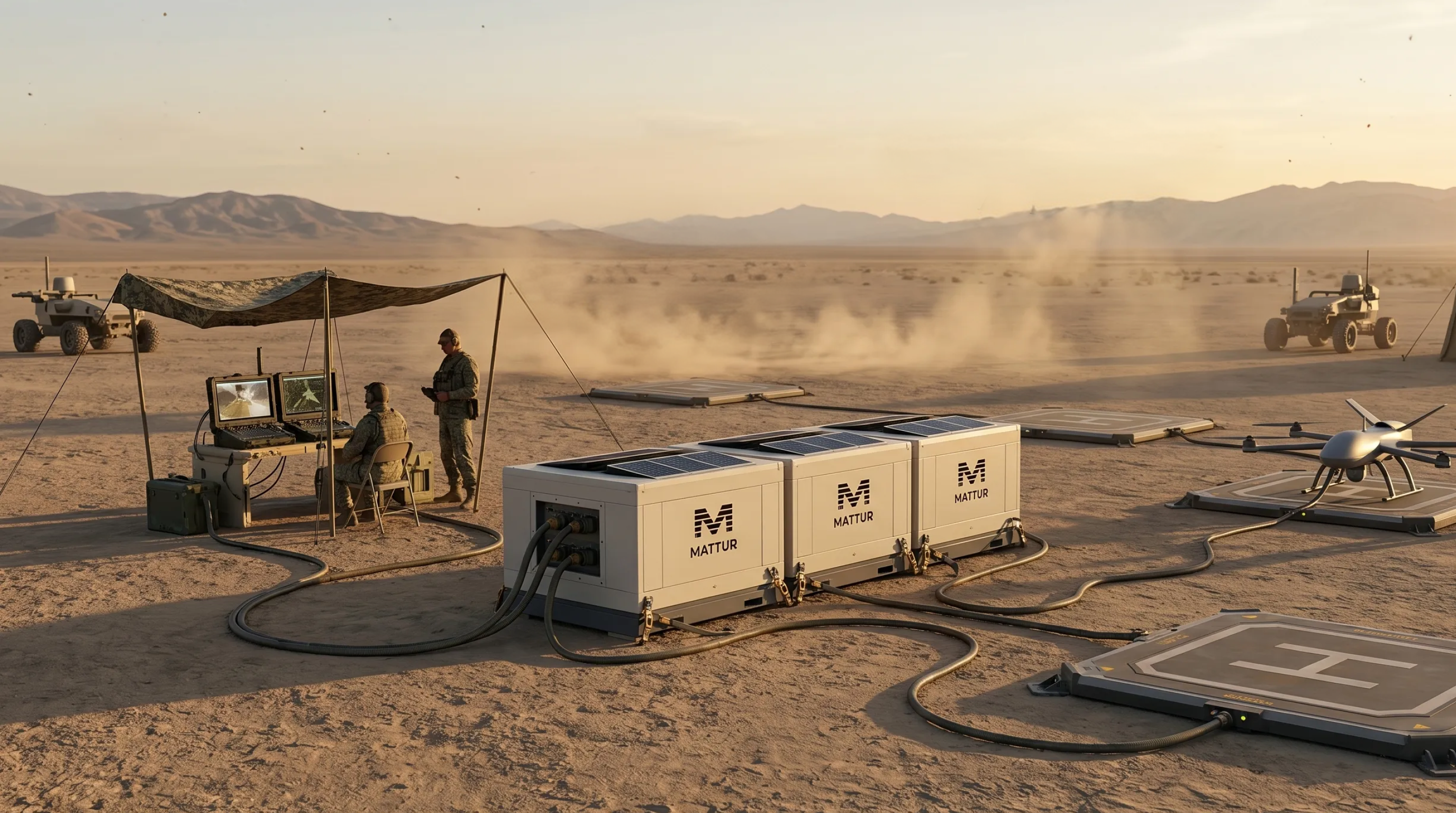
Persistent aerial systems
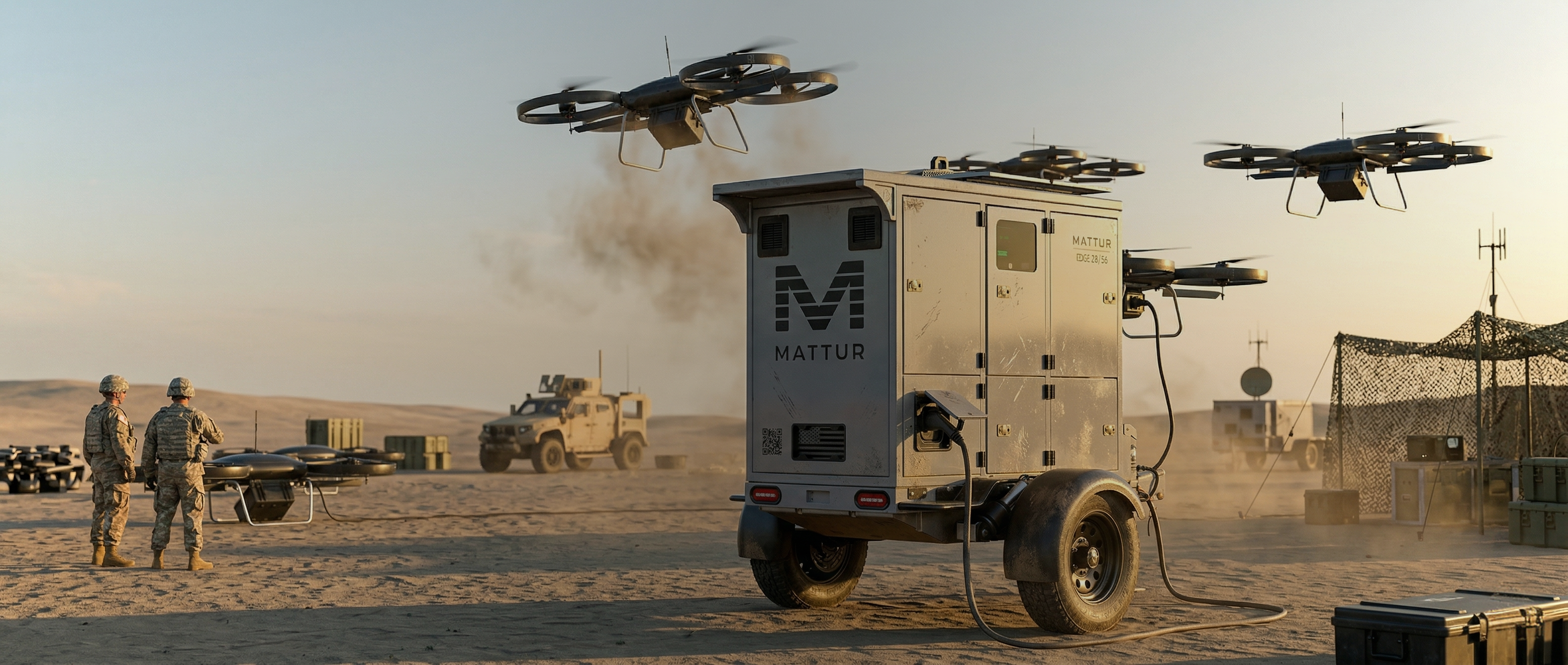
Stable, responsive power for drone charging and sustained launch-and-recover operations. Supercapacitor architecture handles sharp transient loads without battery complexity.
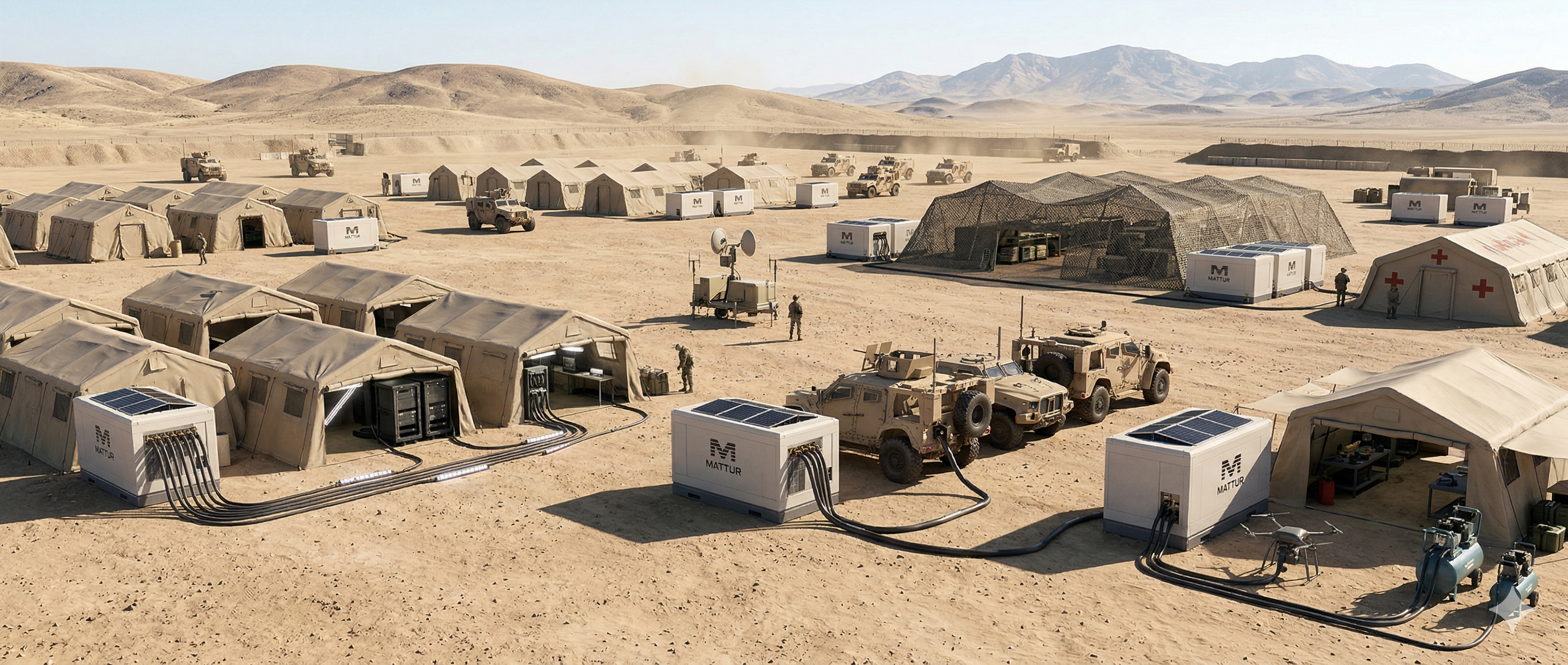
Forward operating bases
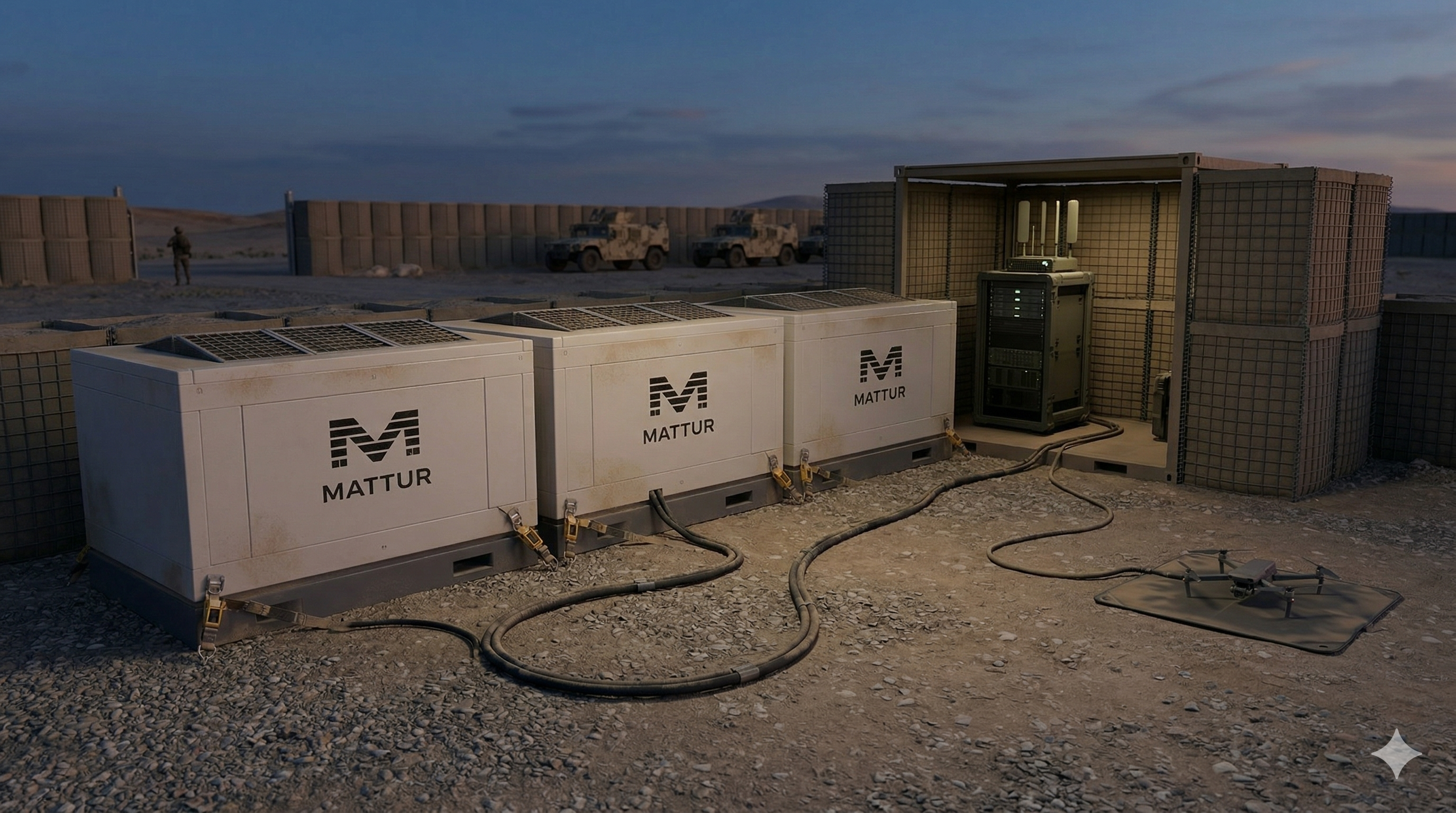
Sustained output, fault tolerance, and linear scalability. No single point of failure, 20–30% lower fuel consumption than conventional generation.
Long-duration, low-intervention operation
Duty cycle determines runtime. A drone charging application running intermittent cycles operates very differently from a FOB on prime power. The architecture handles both — efficiently at low duty cycles, reliably at high ones.
Decoupled by design.
One self-contained unit. Purpose-built components. The same system that ships is the same system still running months later.
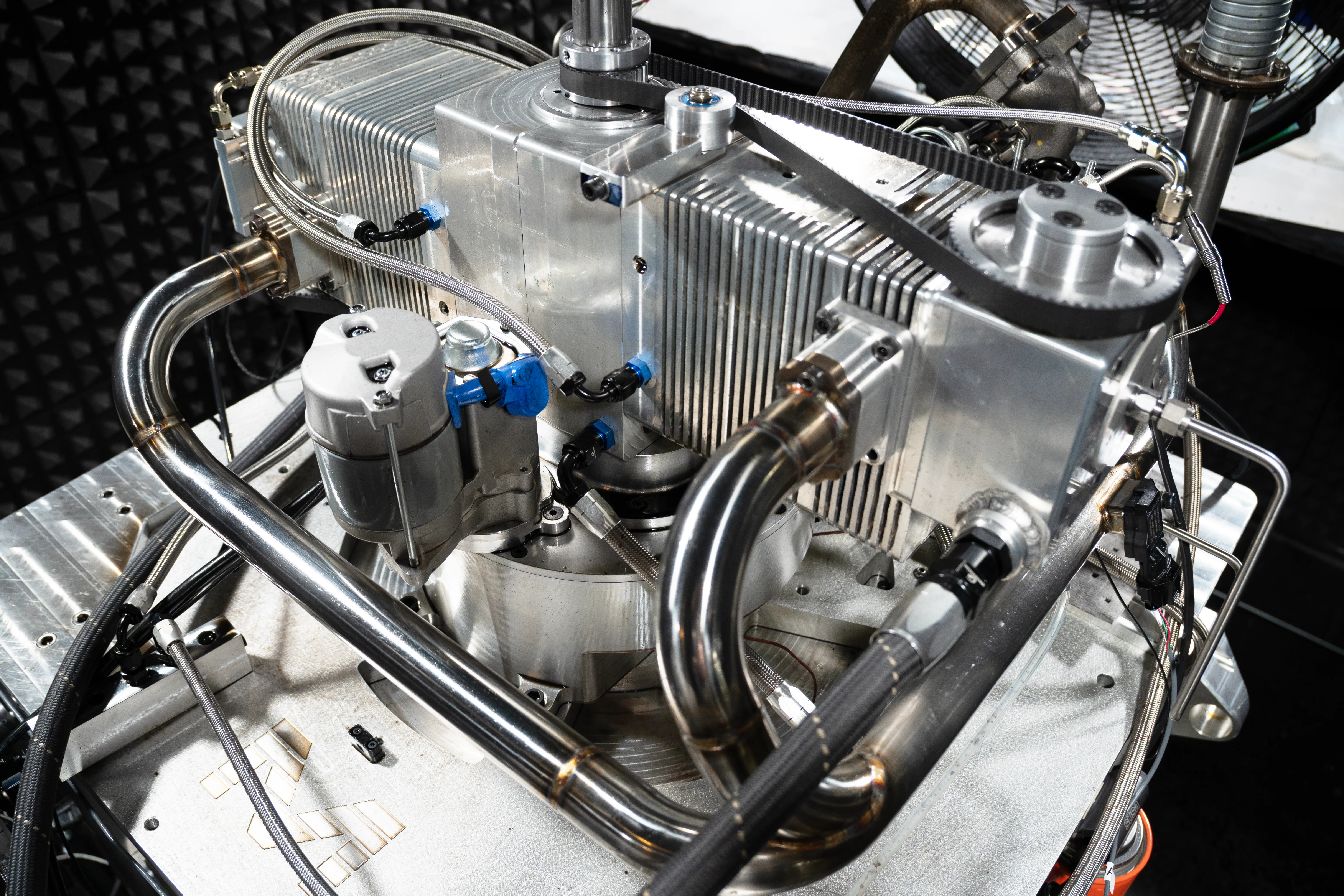
Built from the ground up. The Meridian Twin wasn't adapted from a commercial engine. Designed in Phoenix for continuous-duty operation in high-vibration, extreme-temperature environments, it's governed by a proprietary FPGA-based ECU with microsecond load-response.
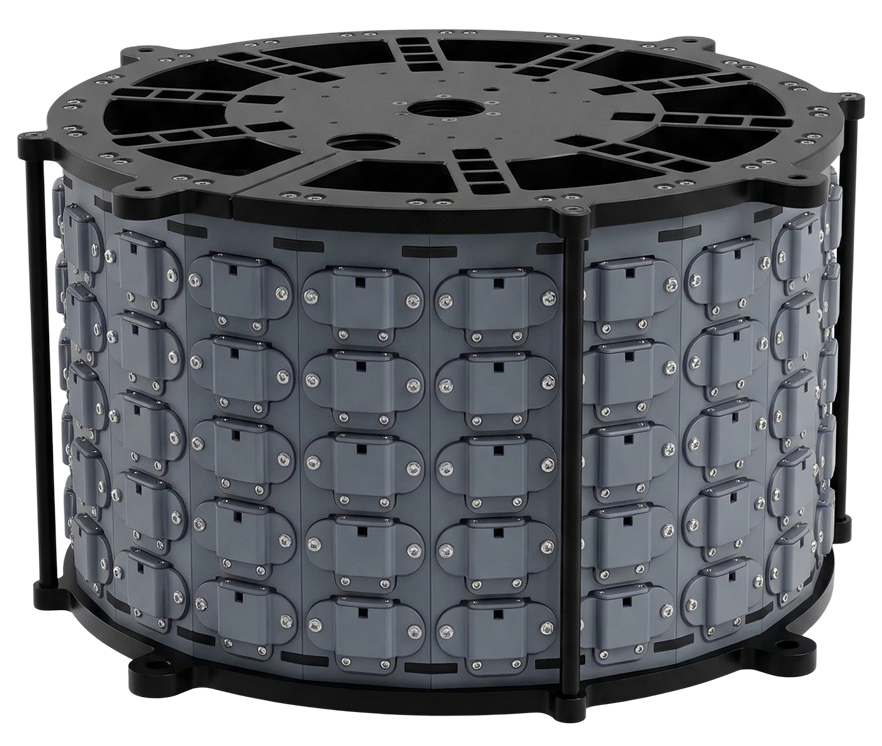
Stable power across any load profile. The PulseTech generator and supercapacitor bank absorb demand spikes instantly, without batteries. Transient loads are handled in milliseconds with no effect on connected equipment. A module fault results in reduced available capacity rather than cascading failure or system shutdown.
Air-cooled. Common-rail direct injection. Compatible with Diesel #2, Diesel #1, JP-8, JP-5, kerosene, and biodiesel blends. No lithium chemistry, no thermal management infrastructure, no specialized logistics. If you can maintain a diesel, you can maintain this.
Platform Configurations
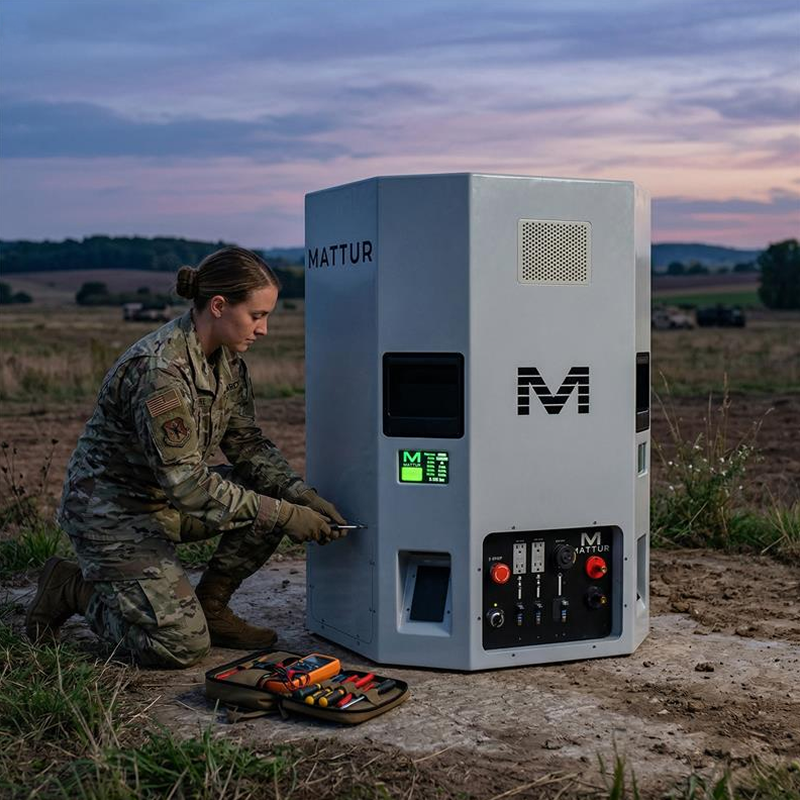
Every Mattur system is built from one unit: the Mattur Power Module. 20 kW continuous. 36 kW peak. 16 kW of supercapacitor surge on tap for the loads that spike, on a single module. Modules operate alone or stack in parallel with no synchronization equipment and no ceiling on scale — one architecture from a single module to a megawatt and beyond.
20 kW
Power Module
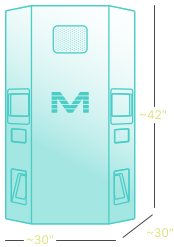
Edge 40 Trailer
Up to 2, 20 kW Power Modules

Edge 80 Trailer
Up to 4, 20 kW Power Modules

Skid-mounted Power Block 200kW
Scales without limit

Architecture Comparison
Three architectures. One operates without compromise.
| Operational Factor | Conventional | Battery-Hybrid | |
|---|---|---|---|
| Compute/sensor power spikes | Governor lag, voltage droop | Batteries absorb, add mass | Instant, no battery cycling |
| Transient handling | Engine responds directly | Lithium batteries buffer | Supercapacitors buffer |
| Efficiency at variable load | Inefficient, wet-stacking risk | Improved, higher system burden | High efficiency at mid-load |
| Acoustic/thermal signature | Tonal RPM, constant exhaust | Reduced intermittently | Reduced, steadier exhaust |
| Power factor | 0.8 (derated) | 0.8–1.0 (variable) | 1.0 (inverter-driven) |
| Operational complexity | Low | High (BMS, safety overhead) | Low, no lithium BMS |
| Logistics | Heavy fuels only | Heavy fuels + lithium logistics | Heavy fuels only |
| Scaling | Monolithic, fixed-size units | Limited, battery-dependent | Modular 20 kW blocks |
Performance data from testing. Technical documentation available upon request.
American Design and Manufacturing
Designed and manufactured in the United States by a team of aerospace and defense engineers in Phoenix, AZ.
Domestic Manufacturing
Designed and manufactured in the United States. Full supply chain visibility from raw materials to finished system.
Factory-Direct Service
24-hour response target. One manufacturer behind the engine, generator, controls, and enclosure. No dealer intermediary.
One Training Pipeline
Standardize on one modular platform. One parts inventory, one maintenance procedure, one support contact.
Fuel Savings Calculator
What is your generator really burning?
Enter your current genset's fuel economics and see what Mattur saves you. Real operating burn, not inflated full-load numbers.
Your Current Genset
USD per gallon
Average running time per day
Not sure of your burn?
Most legacy diesel units run at 30 to 50 percent load, where they burn fuel inefficiently.Typical load 50%
Generator size 60 kW
How it works: baseline = fuel cost x gallons per hour x runtime. Annual = baseline x days per week x 52 weeks. Savings range applies a 20 to 30 percent fuel reduction from Mattur's generator technology.
Figures reflect fuel cost only and exclude DEF, maintenance, downtime, and other ownership costs. Estimates for illustration; actuals vary by load, duty cycle, and site conditions.
One platform. Every mission.
American-built.
We work directly with defense contractors, systems integrators, and program offices. If you're designing a platform with a power problem, we'd like to understand it.