Portable Power for Live Events: What Concert and Festival Producers Need
No grid access. Noise restrictions. Multi-day runtimes. Here's how production teams are solving the power problem at remote venues — and what changes when you get it right.
Live event power has one non-negotiable requirement: it cannot fail. Not during soundcheck. Not during the main act. Not during the headline set on night two of a three-day festival. Power is the problem that nobody in the audience should ever know about.
Remote venues make this harder. A festival field, a race circuit, a film location in the mountains — these places don’t have grid connections sized for production loads. You’re bringing your own power, and everything flows from that decision.
The Three Problems Legacy Generators Create
1. Noise
Standard rental generators run at fixed 1,800 RPM to maintain 60 Hz output. That means constant engine noise at full throttle — whether the load is 10 kW or 60 kW. At partial load (which is most of the show), the engine is still screaming. Acoustic barriers help at the edges of the sound design problem, but they don’t solve it.
Variable-RPM machines change this. When load is low — during load-in, between sets, while the headliner does a sound check — the engine backs off to match actual demand. Less load, lower RPM, quieter operation. The engine only surges when the production demands it.
2. Mixed Loads
Stage power, FOH audio, lighting rigs, broadcast infrastructure, backstage HVAC, and catering all run simultaneously. They run different load types — single-phase for most small loads, three-phase for large HVAC compressors and certain broadcast equipment. Legacy generators force a choice: one unit for single-phase, another for three-phase. That’s two generators, two fuel chains, two failure points.
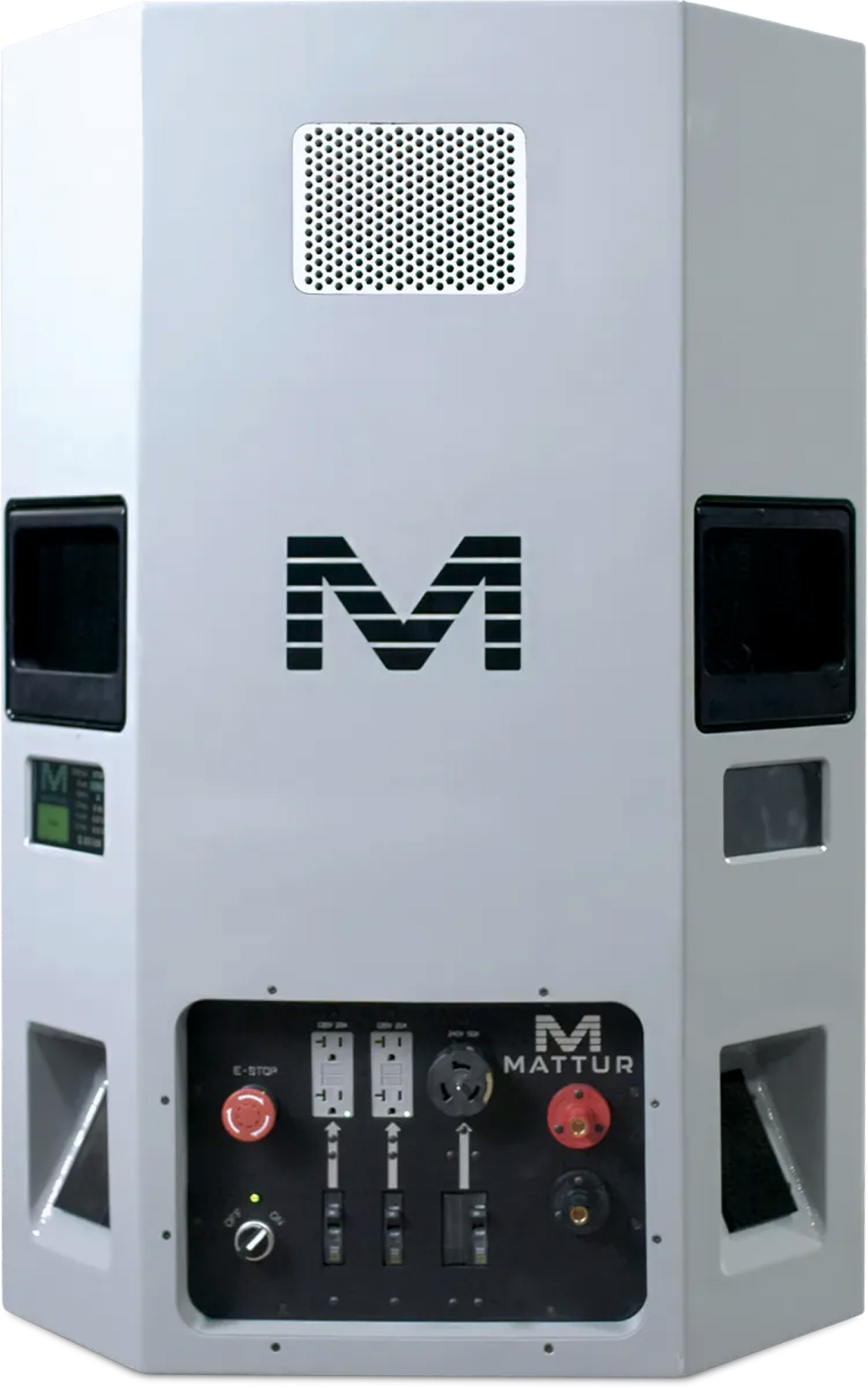
Mattur’s 14 kW modules output simultaneous single- and three-phase power from one system. One Edge 56 trailer covers the whole mixed-load production without running separate units for different phases.
3. Multi-Day Logistics
Three-day festivals require continuous power. Standard generators may need 8–12 hour refuels depending on load. Coordinating fuel delivery to a remote venue while a production is live is a logistics headache that compounds everything else going wrong.
Mattur’s Edge trailers carry 175-gallon integrated fuel tanks. The Power Block configuration adds a 500-gallon tank. Fewer refuels. Predictable logistics. Uninterrupted runtime.
How Production Teams Are Sizing It
| Production Scale | Recommended Config | Continuous Output |
|---|---|---|
| Single-stage, smaller venue | Edge 28 | 28 kW / 56 kW surge |
| Full festival, multiple stages | Edge 56 | 56 kW / 112 kW surge |
| Major event, F1 paddock, multi-stage | Power Block | Up to 140 kW / 280 kW surge |
The Power Block goes further: module-level redundancy means one unit going down never interrupts the event. The system keeps running at reduced capacity while a module is serviced. That’s the architecture difference between a generator and a platform.
What Changes When You Get Power Right
The best production events have one thing in common: nobody on stage or in the audience knows the power system exists. It’s invisible infrastructure. Every problem it doesn’t create is time the production team spends on the show instead of the generator.
Mattur’s factory-direct service model is part of this. If something goes wrong, the response isn’t a dealer queue. It’s a 24-hour target from the manufacturer — the same people who built the system. On a multi-day event, that’s the difference between a minor incident and a catastrophe.
See Mattur’s event power systems — Edge 28, Edge 56, and Power Block configurations sized for live productions.