Sizing Backup Power for Data Centers: NFPA 110, Tier Requirements, and Load Calculations
What it actually takes to size backup power for a data center correctly. The standards that govern it, the load math operators get wrong, and how modular changes the calculation.
The hard part of sizing backup power for a data center is not the math. The math is straightforward once the inputs are right. The hard part is getting the inputs right, in a building where loads change every quarter, regulators expect documentation, and the cost of getting it wrong is measured in lost revenue per second.
Data center backup is one of the most demanding applications in the entire backup power market. The loads are large, the redundancy expectations are absolute, and the standards are non-negotiable. A 10-megawatt facility cannot afford a 10-minute outage during transfer. It cannot afford a generator that starts but fails to hold the inrush of a chiller plant. It cannot afford a fuel logistics gap during a regional grid event.
Here is what backup power sizing actually requires, what most operators get wrong, and what changes when the platform is modular instead of monolithic.
Start With the Standard, Not the Spec Sheet
NFPA 110 is the governing standard for emergency and standby power systems in the United States. Every backup power conversation starts there, whether the facility is a hospital, an industrial plant, or a hyperscale data center. The standard defines two levels:
- Level 1 covers systems where failure could result in loss of human life or serious injury. Life-safety circuits, fire pumps, emergency lighting, and ventilation for hazardous environments fall here. Level 1 requires a 10-second start-to-load transfer.
- Level 2 covers systems where failure is less critical but still consequential. Most non-life-safety IT loads in a data center are Level 2.
A typical data center carries both. The life-safety bus serves the building’s emergency lighting, smoke control, and egress. The standby bus serves the IT plant, cooling, and supporting systems. Those buses can be served by separate generators or by a single plant with appropriately sized transfer switching, and the choice has downstream consequences for tier rating, fuel storage, and concurrent maintainability.
Operators who skip this step end up specifying a generator that meets the wattage target on paper and fails the actual code requirement on day one. The standard comes first. The hardware follows.
Match Tier Target to Physical Redundancy
The Uptime Institute Tier Standard translates availability targets into physical infrastructure requirements. Backup power is one of the most heavily weighted line items.
| Tier | Power Architecture | Availability Target |
|---|---|---|
| I | No redundancy. Single path. | 99.671% |
| II | Redundant capacity components (N+1 generators) | 99.741% |
| III | Concurrently maintainable. Any component can be serviced without dropping IT load. | 99.982% |
| IV | Fault tolerant. 2N power. Isolated distribution paths. | 99.995% |
Tier III is the most common target for new colocation and enterprise builds. It requires N+1 redundancy on every active component, including generators, transfer switches, switchgear, and UPS systems. A facility with five 2-megawatt generators carrying a 10-megawatt critical load meets the N+1 requirement. Lose one generator, and the remaining four still carry the load.
Tier IV requires 2N. That means two independent backup power systems, each capable of carrying the full load, on isolated distribution paths. The cost premium over Tier III is significant, which is why Tier IV deployments concentrate in financial services, defense, and the most demanding hyperscale cloud regions.
The tier target sets the minimum unit count, the topology of the transfer switching, and the size of the fuel storage tank. Get the tier wrong, and the entire mechanical and electrical design downstream is wrong.
Doing the Load Calculation Right
The load calculation has three components, and operators routinely under-specify two of them.
Steady-state load. This is the easy part. Add up the rated IT load, the cooling plant, the building services, and the supporting infrastructure. For a typical 10-megawatt critical IT load, expect roughly 13 to 15 megawatts of total facility load including cooling at a Power Usage Effectiveness of 1.3 to 1.5. The generator must carry 100% of this with margin.
Inrush from motor starts. This is the part that bites. Mechanical cooling equipment, particularly the large chillers and air handlers in a data center plant, draws 3 to 6 times its running current during the first few seconds of startup. A 1.5-megawatt chiller can demand 5 megawatts of starting power for two to three seconds. If the generator is sized only for the steady-state total, it will sag, trip, or fail to start the load when the cooling plant tries to come online after a grid loss.
Sizing must account for the largest single motor start that can occur during the transfer sequence. That is the controlling constraint, not the running average. Generators that hit the steady-state number with no margin for transient surge are the ones that fail their first real test.
Future growth. Data centers add load. The IT density goes up. The cooling demand follows. A backup plant sized exactly to today’s load is a plant that has to be re-engineered in five years. Most operators size to 110 to 125% of measured peak to absorb growth without a forklift upgrade.
Why Modular Changes the Math
Legacy backup design treats the generator as a single point of capacity. A 10-megawatt critical load gets five 2-megawatt generators because that is how the industry has built backup plants for 40 years. Each unit is large, fixed-speed, and either fully on or fully off.
The penalty is structural. To meet Tier III’s concurrent maintainability, the plant has to be oversized. To meet Tier IV’s fault tolerance, the plant has to be doubled. Every additional unit is a major piece of capital and a major piece of physical real estate.
Modular architecture changes the calculation. Instead of five large units, the plant is built from a larger count of smaller modules. Each module operates independently. Each module can be taken offline for service while the rest of the plant continues to carry the load. The N+1 and 2N topologies become a function of how many modules you specify, not a separate redundant plant.
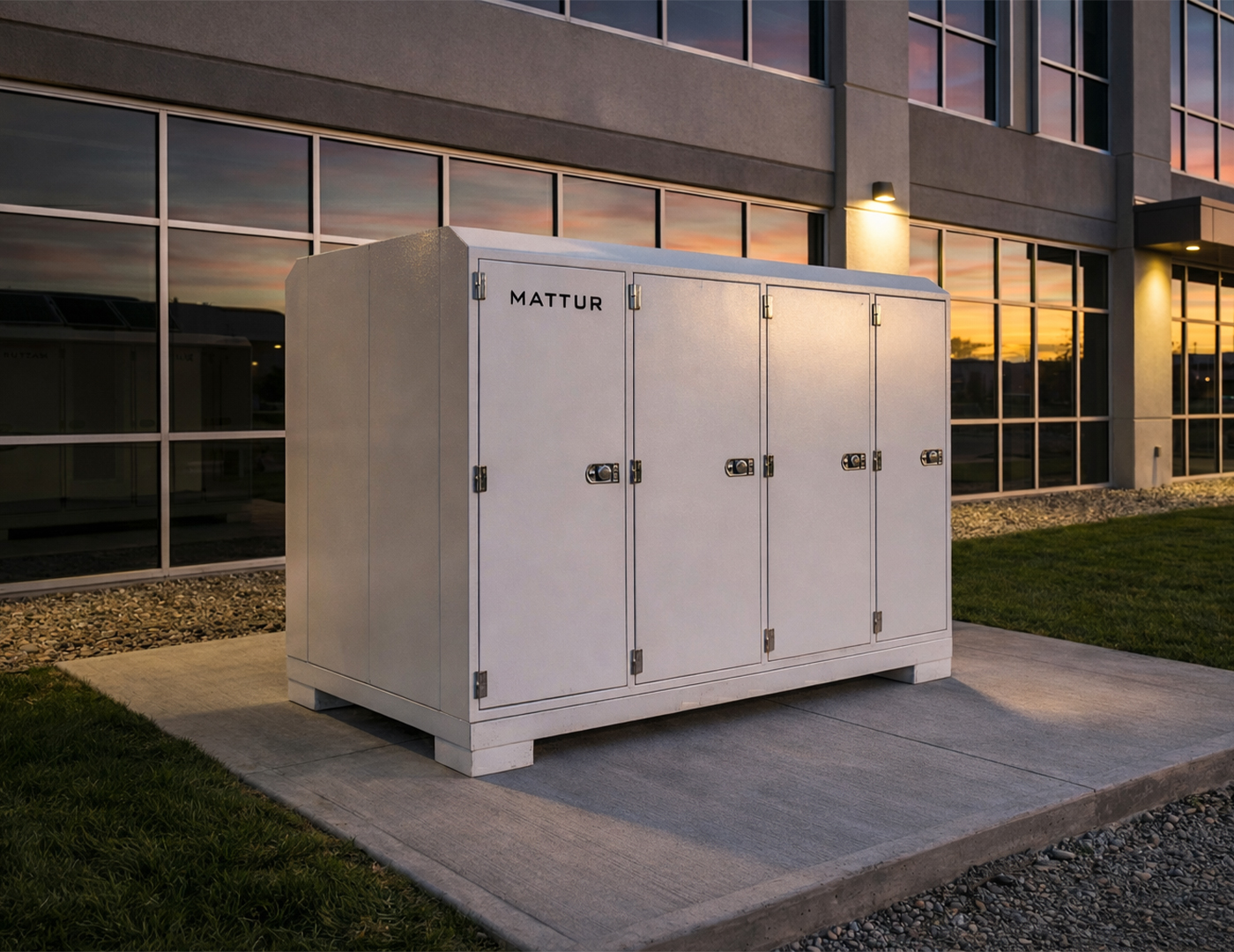
Mattur’s modular backup platform is designed around exactly this principle. A 14-kilowatt building block scales to match the actual facility load, with redundancy built into the count rather than bolted on as a separate machine. The variable-RPM engine in each module also follows real load demand, which means partial-load efficiency is dramatically better than a fixed-speed unit running at 30 to 40 percent of rated output during normal grid-up operation.
For data center operators, two things change. First, the redundancy math gets cleaner. Adding fault tolerance is a question of unit count, not a question of building a second plant. Second, the physical footprint shrinks. A modular plant fits in spaces where a traditional generator hall does not, which matters at the edge and in retrofits where the building was not designed around backup power from the start.
What the Code and the Standard Will Not Tell You
NFPA 110 sets the floor. Uptime Institute Tier ratings set the redundancy target. Neither standard tells you how to handle a real grid event in the third year of operation, when fuel logistics in your region are strained, the cooling plant is bigger than it was at commissioning, and a hurricane has knocked out the local transmission line for a week.
That is where the architectural choice matters more than the spec sheet. A monolithic plant works on day one. A modular plant works on day 2,000, when the conditions are not the conditions it was originally designed for.
For a deeper look at how Mattur applies modular architecture to mission-critical facilities, see our data center backup overview. For the broader platform context, see Mattur backup power.
The bottom line: sizing backup power for a data center is a discipline, not a spreadsheet. Start with the standard. Match the tier target to the physical redundancy. Do the load math with the transient inrush included. Then ask whether the architecture you are buying is the architecture the facility will need in year 10, not just year 1.
That last question is where most legacy designs fail. It is also where Mattur was built to win.