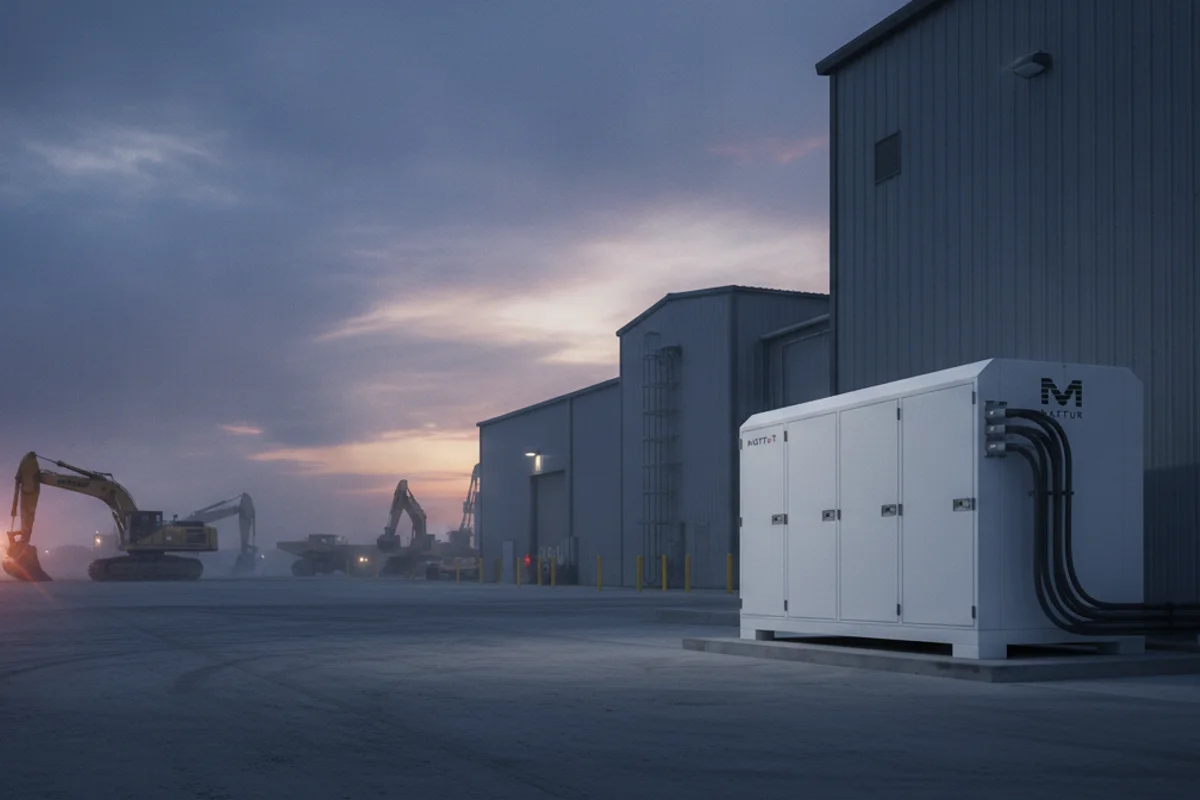
Temporary Emergency Generator Rental for Industrial Sites
Industrial downtime costs thousands per minute. Mattur temporary emergency generator rental deploys fast, runs modular, and holds load when your operation cannot stop.
When a production line goes down, the clock starts immediately. Every minute of unplanned downtime at an industrial facility carries a real dollar cost: idle labor, missed shipments, contractual penalties, and in some cases, scrapped in-process material that cannot be recovered. Temporary emergency generator rental industrial is not a procurement exercise. It is a crisis response where the wrong unit, a late arrival, or a trip on first startup compounds the original outage into a multi-day event. This article covers what industrial operators need to know before the emergency happens, not after.
What Industrial Downtime Actually Costs Per Minute
The cost of industrial downtime is not theoretical. It compounds across labor, throughput, logistics, and contractual exposure simultaneously.
Idle direct labor continues to accrue wages whether the line is running or not. In-process inventory that cannot be completed on schedule may miss customer delivery windows, triggering penalty clauses that are often written into supply agreements as fixed dollar amounts per day or per shipment. For facilities running just-in-time production, a four-hour outage can cascade into a 24-hour recovery window as the line rebalances.
The facilities that feel this most acutely are continuous process operations in energy-intensive manufacturing: chemical processing, food and beverage production, metal fabrication, and plastics manufacturing. In these environments, stopping is not simply inconvenient. It can mean restarting cold equipment, purging contaminated batches, or resetting process conditions that take hours to stabilize.
The calculation that matters for a VP of Operations or plant manager is simple: take the hourly revenue the line generates, add the labor cost of the idle crew, and add any penalty exposure. That is the per-hour cost of the outage. For most mid-size industrial facilities, that number runs well into five figures per hour. For larger operations, it can exceed six figures.
That number is the benchmark against which every decision in an emergency rental engagement should be measured. A unit that arrives four hours late or trips on the first motor start does not save money. It extends the outage.
Why Standard Rental Generators Fail Under Industrial Load
National rental chains carry large inventories of fixed-RPM diesel generators. These units are designed around a straightforward premise: run at 1,800 RPM, produce 60 Hz output, and hold steady-state load. For construction site lighting or a temporary office trailer, that is adequate. For an industrial facility with multiple motor loads, the picture is different.
The first failure mode is sizing. Industrial motors draw three to six times their rated running current at startup, a condition called inrush or hard start. A rental unit sized for the continuous running load of a facility will trip on the first motor start if it has no surge headroom. The result is a generator that arrives, connects, and then trips the moment the first compressor, pump, or conveyor motor starts. The facility is still down, and now there is a generator on-site that is not running.
The second failure mode is load profile mismatch. Industrial facilities rarely run at 100 percent of rated capacity continuously. Load swings as processes cycle, shifts change, and equipment starts and stops. A fixed-RPM generator runs at 1,800 RPM regardless of whether the load is at 30 percent or 90 percent of capacity. At partial load, the engine is burning fuel at a rate disproportionate to the work being done. On a multi-day emergency rental, that inefficiency accumulates into significant fuel cost.
The third failure mode is service response. National rental chains operate through regional depots. A service call at 2 a.m. on a Saturday goes to a call center, gets routed to a dispatcher, and eventually reaches a field technician who may or may not be familiar with the specific unit on-site. For a facility where every hour of downtime has a dollar cost, that response chain is a risk.
How Mattur Modular Architecture Handles Industrial Power Demand
Mattur’s approach to industrial temporary power starts with the 20 kW module as the base unit. Modules combine into trailer-mounted Edge configurations (the Edge 40 at 40 kW and the Edge 80 at 80 kW) and skid-mounted Power Blocks that scale further. The same platform that serves a small process facility also scales to serve a large manufacturing site.
The architecture addresses the hard start problem directly. Mattur’s Intelligent Transient Boost delivers 1.8x peak power for inrush events, absorbing the surge current from motor starts without tripping the unit. This means the system is sized for the continuous load profile, not the worst-case inrush spike. Fewer modules are needed to cover the same facility, which reduces both capital cost and fuel burn.
The architecture also handles simultaneous single-phase and three-phase loads from a single system. Industrial facilities commonly have both: three-phase for large motors and single-phase for controls, lighting, and office circuits. A conventional rental deployment often requires separate units for each load type, with the coordination complexity that creates. Mattur’s system produces both from one platform.
Modular design also provides a practical form of redundancy. In a multi-module deployment, a fault in one module does not take the entire system offline. The remaining modules continue to carry load while the affected module is isolated and swapped. For continuous process operations where stopping is not an option, that architecture matters.
Deployment Speed From Order to Energized Site
Emergency rental engagements are defined by speed. The value of a generator that arrives in 48 hours is fundamentally different from one that arrives in four hours when the line has been down since the previous shift.
Mattur’s trailer-mounted Edge units are configured for rapid deployment. The modular format means units can be transported without the extended rigging and crane work that large single-unit rentals sometimes require. Skid-mounted Power Blocks can be positioned and connected without specialized heavy lift equipment in most industrial yard configurations.
The factory-direct model also removes a layer from the deployment chain. With a national rental chain, the unit in the yard is whatever was available at the nearest depot. With Mattur, the unit that ships is the unit that was built and tested to specification, with documentation available for compliance review before it leaves the facility.
For plant managers who need to confirm generator availability before committing to a deployment plan, Mattur’s direct line is 866-MATTUR-1. Availability confirmation, load profile review, and deployment scheduling happen in a single conversation, not through a ticket queue.
Fuel Efficiency Advantage Over Fixed-RPM Rental Units
Fuel cost is one of the largest variables in an extended emergency rental. A deployment that runs for five to ten days at a large facility can consume thousands of gallons of diesel. The difference between a fixed-RPM unit and a load-following unit is not marginal over that window.
Mattur’s variable-RPM engine follows the actual load rather than running at a fixed 1,800 RPM regardless of demand. When the facility load drops during a shift change or a process cycle pause, the engine scales down proportionally. When load climbs again, it responds. The result is 20 to 30 percent less fuel consumption in typical industrial conditions compared to fixed-RPM alternatives.
Over a week-long emergency deployment, that efficiency gap translates directly into fewer fuel deliveries, lower fuel cost, and reduced logistics complexity for the facility’s operations team. For remote or difficult-access sites where fuel delivery is itself a logistical challenge, the advantage compounds further.
The variable-RPM architecture also reduces engine wear at partial load, which matters for multi-week deployments where the unit is running continuously. Fixed-RPM engines running light loads accumulate wet stacking and carbon buildup that can cause reliability issues over extended operation.
Service Response and Factory-Direct Support Coverage
The question every plant manager should ask before an emergency rental is: what happens if the unit goes down at 2 a.m. on a Saturday?
With a national rental chain, the answer is a call center, a regional dispatch queue, and a technician who may be hours away and may not have worked on the specific unit configuration on-site. For a facility where the cost of downtime is measured in thousands of dollars per hour, that response chain is a meaningful risk.
Mattur’s factory-direct service model is structured differently. The 24-hour response target applies to emergency service calls, including nights and weekends. Factory-direct means the technicians supporting the unit in the field are the same team that built and tested it. They know the architecture, carry the right parts, and do not need to work through a third-party service manual to diagnose a fault.
The 3-year, 3,000-hour warranty that covers Mattur units reflects the same manufacturing confidence. A unit that ships from the Mattur facility in Phoenix has been tested to the same standard whether it is going into a permanent installation or a temporary emergency deployment. The documentation package that accompanies the unit supports compliance requirements for facilities that need to demonstrate generator testing records under NFPA 110, the standard for emergency and standby power systems, for insurance or regulatory purposes.
How to Spec the Right Temporary Power Configuration
Specifying the right temporary power configuration for an industrial emergency does not require a full engineering study. It requires three inputs: the continuous running load, the largest single motor inrush event, and the output voltage requirements.
Start with the continuous running load. Add up the nameplate ratings of all equipment that will run simultaneously on the temporary power circuit. This gives the base module count.
Then identify the largest motor on the circuit. The inrush current for that motor at startup is the surge event the generator must handle without tripping. Mattur’s 1.8x peak power capability covers most industrial motor inrush events without requiring the base module count to be increased for surge headroom alone.
Finally, confirm the output voltage requirements. Industrial facilities commonly need 208V or 480V three-phase for motors and 120/240V single-phase for controls and lighting. Mattur’s platform produces both simultaneously from a single system, which simplifies the transfer switch configuration and reduces the number of units needed on-site.
For enclosed or semi-enclosed deployment areas, also confirm the unit meets EPA Tier 4 Final nonroad emission standards, which apply to the diesel engines used in mobile generation equipment and are commonly required for industrial sites with air quality obligations.
For facilities with complex load profiles, including variable-frequency drives, welding loads, or large lighting circuits with high power factor requirements, Mattur’s team can work through the load profile before deployment to confirm the configuration. That conversation happens before the unit ships, not after it trips on the first startup.
Reach out directly at 866-MATTUR-1 or through the industrial backup power page to start an order or confirm availability for your site.
Getting Power Back on the Line
Industrial emergencies do not follow business hours, and the cost of an extended outage does not pause while a rental chain works through its dispatch queue. The temporary emergency generator rental industrial that actually protects a production operation is the one that arrives fast, starts clean against real motor loads, runs efficiently across a variable load profile, and has factory-direct support behind it when something needs attention at 2 a.m.
Mattur’s modular architecture was built for exactly that requirement: a platform that scales to the site, handles the hard starts that trip conventional rental units, burns 20 to 30 percent less fuel over a multi-day deployment, and carries a 24-hour factory-direct service commitment. When the line is down and the clock is running, those are the specifications that matter.
Call 866-MATTUR-1 or visit the industrial backup power page to confirm availability and start an order.