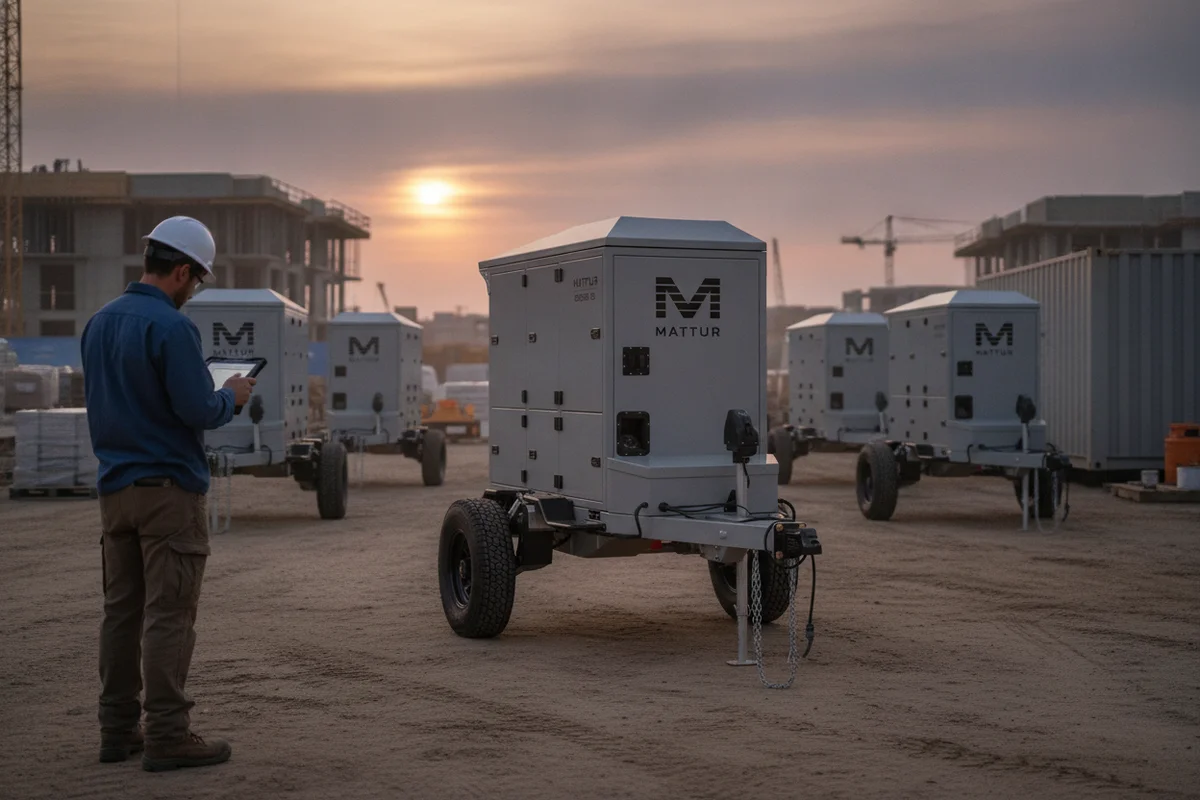
Used Mobile Generator Sets for Sale: What Buyers Need to Know
Buying used mobile generator sets means inheriting someone else's wear. Mattur ships factory-direct, new modular power with a 3yr/3000hr warranty. Get a quote.
The call comes in at 6 a.m. on a Monday. Your crew hits the site at seven, the superintendent needs three-phase power running before the concrete pump arrives at eight, and the used diesel unit you pulled from the yard last week is throwing a fault code nobody recognizes. The parts hotline puts you on hold. The auction house where you bought it does not have a service department. The concrete truck is 40 minutes out. That is the risk of buying used, compressed into a single morning. The acquisition price looked right on paper. The operating reality is something else.
This article is for fleet managers and equipment procurement teams who are actively weighing used generator sets against new alternatives. The economics are real on both sides. So are the failure modes.
Why Buyers Search for Used Mobile Generator Sets
The search for used mobile generator sets starts in the same place every time: the sticker price on new OEM product. A new diesel genset from one of the four major manufacturers lists at a price point that, for a regional GC running four to six units across a project portfolio, adds up fast. Auction houses and used equipment dealers offer units at significant discounts, and for a buyer who needs power on a job that starts in two weeks, the math can look compelling.
There are legitimate reasons to buy used iron. If you have a short-duration project, a known-history unit from a fleet you trust, and a service relationship that covers the platform, a used generator can work. The problem is that most used generator transactions do not look like that. They look like an auction listing with 4,200 hours, a photo of the nameplate, and a note that says “runs good.”
The buyers who end up in the most trouble are the ones who treat a used generator purchase the same way they treat a used pickup truck purchase. A pickup with deferred maintenance costs you a repair bill. A generator with deferred maintenance costs you a jobsite shutdown, a concrete pour rescheduled, a superintendent on the phone with the GC, and a rental unit mobilized at emergency rates to cover the gap.
What Used Generator Sets Actually Cost Operators
The acquisition price is the number that shows up on the purchase order. The operating cost is the number that shows up in your P&L over the next three to five years, and those two numbers have a complicated relationship.
Legacy mobile generators run fixed-RPM architecture. The engine turns at 1,800 RPM whether the load is 15 kW or 60 kW. On a typical jobsite, actual load runs at 30 to 50 percent of rated capacity for most of the shift. The engine is burning fuel at near-full-throttle conditions to produce partial-load output. That gap between fuel consumed and work produced is a direct operating cost that compounds across every hour the unit runs.
Oversizing makes this worse. Because legacy architecture requires the unit to be sized for inrush events (motor starts, welding, crane operations), buyers routinely deploy a 100 kW unit on a site where continuous demand is 35 to 40 kW. The unit idles at partial load all day, burning fuel it does not need to burn, and the buyer paid for 100 kW of capacity they use for approximately 30 seconds at a time when the crane cycles.
Used units add a third cost layer: maintenance catch-up. A unit with 4,000 hours and an incomplete service history likely has deferred injector work, coolant system maintenance, and potentially turbo wear that the previous owner did not address before selling. That deferred work transfers to the buyer at acquisition and surfaces as repair bills during the ownership window, often at the worst possible time.
Parts availability on legacy platforms is a separate problem. When a major OEM unit needs a specific injector or control board, lead times from the dealer network can stretch two to four weeks on older models. That is two to four weeks of downtime on an active jobsite, covered by a rental unit at emergency rates, while you wait for a part that should have been stocked.
EIA Construction Cost Benchmarks for Generator Buyers
Understanding where your capital is going requires context on what generators actually cost to build and deploy. The U.S. Energy Information Administration tracks capacity-weighted average construction costs across generator types, and the 2023 data gives useful reference points for buyers evaluating mobile power investments.
Per the EIA, the capacity-weighted average construction cost for internal combustion engine generators in 2023 was $1,248 per kW. Petroleum liquids generators came in at $906 per kW. These figures reflect installed costs at the utility and commercial scale, but they establish a baseline for understanding why mobile generator acquisition costs are what they are, and why the economics of right-sizing matter so much.
A buyer who deploys a 100 kW unit on a 35 kW continuous load site is not just paying for excess capacity at acquisition. They are paying to operate that excess capacity every hour the unit runs, in fuel burned at inefficient partial load. At $906 to $1,248 per kW of installed capacity, the decision to oversize by 60 kW carries real cost consequences that show up in fuel bills, not just on the purchase order.
The EIA data also reinforces why total cost of ownership calculations need to start with the load profile, not the nameplate. Buying used iron at a discount on a 100 kW unit when your site needs 35 kW continuous is not a savings. It is a deferred cost.
Factory-Direct New Units Versus Used Market Trade-offs
The used market trade-off comes down to three variables: acquisition cost, operating cost, and service risk. Used units win on acquisition cost, almost always. Operating cost and service risk are where the math turns.
A new factory-direct unit ships with a known service history (zero hours), a known configuration, and a direct relationship with the manufacturer for parts and support. When something goes wrong, you call the factory, not a dealer who may or may not have your part in stock. That distinction matters most at 6 a.m. on a Monday when the concrete truck is 40 minutes out.
The factory-direct model also changes the service economics. Legacy dealer networks are structured around margin at every layer: OEM to regional distributor to local dealer to service technician. Each layer adds cost and adds latency to the parts and service chain. Factory-direct removes those layers. The buyer deals with the manufacturer, and the manufacturer has direct visibility into the unit’s configuration and service history.
Air-cooled architecture is a specific advantage worth calling out for buyers who have managed liquid-cooled units in the field. Coolant systems require regular maintenance (fluid changes, hose inspection, radiator cleaning), and they accumulate scale and corrosion over time that creates failure modes that do not show up until the unit is under load in a hot environment. An air-cooled unit removes that entire failure category. Fewer components, fewer maintenance touchpoints, fewer ways for deferred maintenance to bite you.
Fuel Savings Calculator
What is your generator really burning?
Enter your current genset's fuel economics and see what Mattur saves you. Real operating burn, not inflated full-load numbers.
Your Current Genset
USD per gallon
Average running time per day
Not sure of your burn?
Most legacy diesel units run at 30 to 50 percent load, where they burn fuel inefficiently.Typical load 50%
Generator size 60 kW
How it works: baseline = fuel cost x gallons per hour x runtime. Annual = baseline x days per week x 52 weeks. Savings range applies a 20 to 30 percent fuel reduction from Mattur's generator technology.
Figures reflect fuel cost only and exclude DEF, maintenance, downtime, and other ownership costs. Estimates for illustration; actuals vary by load, duty cycle, and site conditions.
Mattur Power Module Deployment Speed and Reliability
The Mattur Power Module is built around four first-principles technologies that work together as a system: the Meridian Twin engine, PulseTech, a supercapacitor bank, and an inverter that orchestrates all three. The result is a unit that is 40 percent smaller than comparable legacy gensets, with a footprint that fits tighter jobsite configurations and deploys faster.
The Meridian Twin runs variable RPM from 1,000 to 4,500 RPM, following actual load instead of idling at fixed 1,800 RPM. At the 30 to 50 percent partial loads that dominate real jobsite conditions, that variable-RPM architecture delivers 20 to 30 percent fuel savings compared to legacy fixed-RPM units. That is not a spec sheet number. It is the savings that shows up in your fuel log across a 12-month project.
The supercapacitor bank handles inrush events (motor starts, welding, crane cycles) without requiring the engine to be oversized for surge headroom. The unit is sized for your continuous load. Surge capacity is handled by the supercapacitor bank, which delivers 1.8x rated surge capacity for inrush events. That is the architectural reason you do not need to deploy a 100 kW unit on a 35 kW site.
PulseTech enables parallelization, so the same 20 kW module scales from a single unit to a multi-module array as the project grows. You are not buying a new generator when the project phases up. You are adding modules to the same platform. The Edge series deploys trailer-mounted for rapid mobilization. The Power Block series ships skid-mounted for fixed installations. Same module, same control architecture, same parts inventory.
Simultaneous single-phase and three-phase output from one unit eliminates the step-down transformer and the additional small portable that most jobsites run alongside the main generator. One unit covers the full load mix.
Warranty Coverage That Used Units Cannot Match
Most used generator sets sell at auction with no warranty, or with a 30 to 90 day dealer warranty that covers catastrophic failures only. That window closes before the unit has accumulated enough hours to surface the deferred maintenance issues that were present at purchase.
The Mattur Power Module ships with a 3-year, 3,000-hour warranty, factory-direct. That coverage window spans the full early ownership period for most commercial deployments. If something goes wrong during that window, you are dealing with the manufacturer, not a dealer who is managing their own margin and parts inventory.
The 24-hour response target matters as much as the warranty term. A warranty that takes two weeks to activate because parts are backordered at the regional distributor is not a real warranty for an active jobsite. Factory-direct means the response chain is shorter and the parts availability is direct.
The air-cooled Meridian Twin architecture also reduces the warranty claim surface area. No coolant system means no coolant system failures. No DEF/SCR after-treatment means no DEF contamination, no cold-weather DEF management, and no SCR catalyst failures. The most common failure modes on legacy liquid-cooled diesel units are simply not present in the architecture.
For a fleet manager evaluating total cost of ownership, the warranty math is straightforward. A used unit with no warranty and deferred maintenance carries an unknown repair liability from day one. A new factory-direct unit with a 3-year, 3,000-hour warranty carries a known cost structure across the ownership window.
How to Spec the Right Mobile Generator for Your Site
Sizing starts with your actual continuous load, not your theoretical peak. Pull your load data from the last comparable project if you have it, or estimate from your equipment list: each piece of equipment has a running load and an inrush load. Add up the running loads to get your continuous demand. That is the number you size to.
With legacy architecture, you add 50 to 100 percent headroom for inrush, which is why jobsites end up with 100 kW units serving 35 kW loads. With a system that handles inrush through a supercapacitor bank, you size to continuous demand and let the surge handling cover inrush events. The unit is smaller, the acquisition cost is lower, and the fuel burn at partial load is dramatically reduced.
Check your phase requirements early. If your site runs both single-phase tools and three-phase equipment (motors, welders, compressors), a unit that outputs both simultaneously from one system eliminates the step-down transformer and the secondary portable. That is one fewer unit to mobilize, one fewer fuel connection, one fewer maintenance item.
Verify Tier compliance against your project requirements before you commit to any unit, new or used. Federally funded projects increasingly require Tier 4 Final compliance, and the fuel-cost math shifts again once you account for it. California Air Resources Board rules apply regardless of project funding source. A used Tier 3 unit that is legal on your current private commercial site may create compliance exposure on your next bid if the project carries federal dollars or operates in a regulated air basin. That is not a hypothetical. It is a bid qualification issue.
For fleet operators evaluating the modular platform, the single-SKU advantage compounds at scale. The same 20 kW module covers a downtown jobsite, a remote oil and gas pad, and a continuous mining operation without three separate engine families to support. One parts inventory, one technician training program, one control architecture across the full power range. The operational drag of managing four to six generator SKUs across three engine families is a real cost that does not show up in the per-unit acquisition price but shows up every month in parts holding cost, technician time, and repair downtime.
The Bottom Line on Used Mobile Generator Sets
The buyer who calls at 6 a.m. with a fault code and a concrete truck 40 minutes out is not having a bad luck day. They are having a predictable outcome from a used unit with unknown service history and no factory support behind it.
The used market for mobile generator sets will always exist, and there are situations where it makes sense. But for a fleet manager or procurement team running active jobsites where downtime has a direct cost, the math on used iron is harder than the acquisition price makes it look. Fuel burn at partial load, maintenance catch-up, parts lead times, and the absence of warranty coverage all compound across the ownership window.
Factory-direct new units with variable-RPM architecture, built-in surge handling, and a 3-year, 3,000-hour warranty change that math. The acquisition cost is higher. The 5-year total cost of ownership is lower. The 6 a.m. phone call is shorter, because there is a factory service team on the other end of it.
Call 866-MATTUR-1 or start an order to get pricing and availability on the Power Module configuration that fits your site.