Mobile Diesel Generator Set for Rent: What to Know
Renting a mobile diesel generator set means matching fuel burn, phase output, and site constraints to the right unit. Here is how Mattur Power Modules fit.
When a rental branch manager specs a mobile diesel generator set for rent, the spec sheet conversation usually starts with kVA and ends with delivery date. What it rarely covers is what the unit actually costs to run at the load profile the jobsite will see for the next 90 days. That gap between nameplate capacity and real-world operating cost is where rental economics fall apart, and it is the gap that most legacy diesel architecture was never designed to close.
This article is written for the people who manage rental fleets and field customer calls about generator availability, not for the end buyer reading a brochure. The goal is a practical look at what drives total cost on a mobile generator rental, where standard specs mislead, and how Mattur Power Modules are configured to fit the rental application from the first deployment.
Why Jobsite Constraints Break Standard Rental Specs
A standard rental spec covers rated kVA, fuel tank size, and emissions tier. It does not cover the three constraints that actually determine whether a unit works on a specific site.
The first is noise. Urban construction, events near residential areas, and hospital-adjacent sites all carry noise ordinance limits that open-frame diesel units exceed at normal operating RPM. A unit rated at 72 dB at 7 meters may be compliant on a rural highway project and a code violation two miles away at a mixed-use development. Rental branches that cannot offer a quieter alternative decline the rental or subrent at margin compression.
The second is emissions tier. Most active US construction sites require Tier 4 Final compliance. Units with DEF and SCR after-treatment meet the standard but add a consumable management burden, cold-weather complications, and a contamination failure mode that shows up in the field at the worst possible time. Tier 4 Final without DEF is a different architecture, not a spec upgrade.
The third is footprint. Tight urban sites, confined staging areas, and trailer-access-only locations put a hard limit on the physical size of the unit a branch can deploy. A 40 percent smaller footprint is not a marketing number when the alternative is telling a customer the unit does not fit the gate.
Standard rental specs address none of these three constraints directly. They describe the generator in isolation, not the generator on the site.
What a Mobile Diesel Generator Set Actually Costs to Run
The rental invoice is the smallest part of the cost. On a 30-day rental at typical construction utilization, fuel often exceeds the rental line item by a factor of two or more. The DOE backup power cost of ownership analysis notes that diesel generators represent the incumbent technology benchmark precisely because their total cost of ownership is well understood, and fuel dominates that calculation.
Delivery, pickup, fuel delivery runs, and any service calls round out the real cost. A unit that requires a fuel run every four days on a remote site adds logistics cost that does not appear on the rental agreement. A unit that requires a service call for a DEF contamination issue adds downtime cost that the customer remembers at the next rental cycle.
For the rental branch, the economics show up differently. Gross margin on mobile generator rentals runs in the 35 to 50 percent range for mature platforms, per public filings from national rental operators. That margin erodes when fuel runs, service calls, and technician time on a single unit eat into the revenue it generates. A unit with lower operating cost and fewer service touchpoints produces better margin on the same rental revenue, not just a better customer experience.
Single Phase Versus Three Phase Output on Active Sites
Active construction sites run mixed loads. Office and job trailers run on 120/240V single-phase. Larger tools, compressors, concrete equipment, and HVAC units run on 208V or 480V three-phase. A site superintendent managing both does not want to manage two generators or a step-down transformer between them.
Legacy mobile diesel units handle this with a selector switch or by derating one phase to support the other. Multiquip’s published specs, for example, document a derating from 56 kW three-phase to 40 kW single-phase on the same unit. That 16 kW gap is not a rounding error. It is the difference between a unit that covers the site and one that does not.
Mattur Power Modules output 120/240V single-phase and 208V or 480V three-phase simultaneously from the same unit, managed by the inverter architecture rather than a selector switch. The site gets full capacity on both phases without a second unit or a transformer. For the rental branch, that means one unit on the manifest instead of two, and a simpler delivery and pickup.
How Fuel Burn at Partial Load Drives Total Rental Cost
This is the number that changes the conversation with customers who are comparing rental quotes.
A fixed-RPM diesel generator runs at 1,800 RPM regardless of the load the site is drawing. At 20 to 30 percent utilization, which is where many jobsites spend most of their operating hours during early phases and between active work cycles, fuel consumption on a fixed-RPM unit is often 60 to 70 percent of full-load consumption. The engine is burning fuel to maintain RPM, not to do work.
Mattur’s Meridian Twin engine runs variable RPM from 1,000 to 4,500 RPM, following actual load rather than holding a fixed operating point. The result is 20 to 30 percent lower fuel consumption in typical jobsite conditions. On a 30-day rental at $5 per gallon diesel, that reduction compounds into a number the customer notices on their project cost sheet.
For the rental branch, the fuel efficiency story is a sales tool. A customer comparing two rental quotes at similar day rates will choose the unit with lower projected fuel cost if the branch can show the math. The branch that can show the math wins the rental.
Fuel Savings Calculator
What is your generator really burning?
Enter your current genset's fuel economics and see what Mattur saves you. Real operating burn, not inflated full-load numbers.
Your Current Genset
USD per gallon
Average running time per day
Not sure of your burn?
Most legacy diesel units run at 30 to 50 percent load, where they burn fuel inefficiently.Typical load 50%
Generator size 60 kW
How it works: baseline = fuel cost x gallons per hour x runtime. Annual = baseline x days per week x 52 weeks. Savings range applies a 20 to 30 percent fuel reduction from Mattur's generator technology.
Figures reflect fuel cost only and exclude DEF, maintenance, downtime, and other ownership costs. Estimates for illustration; actuals vary by load, duty cycle, and site conditions.
Mattur Power Module Configuration for Rental Applications
The Mattur Power Module is available in two enclosure form factors for rental deployment.
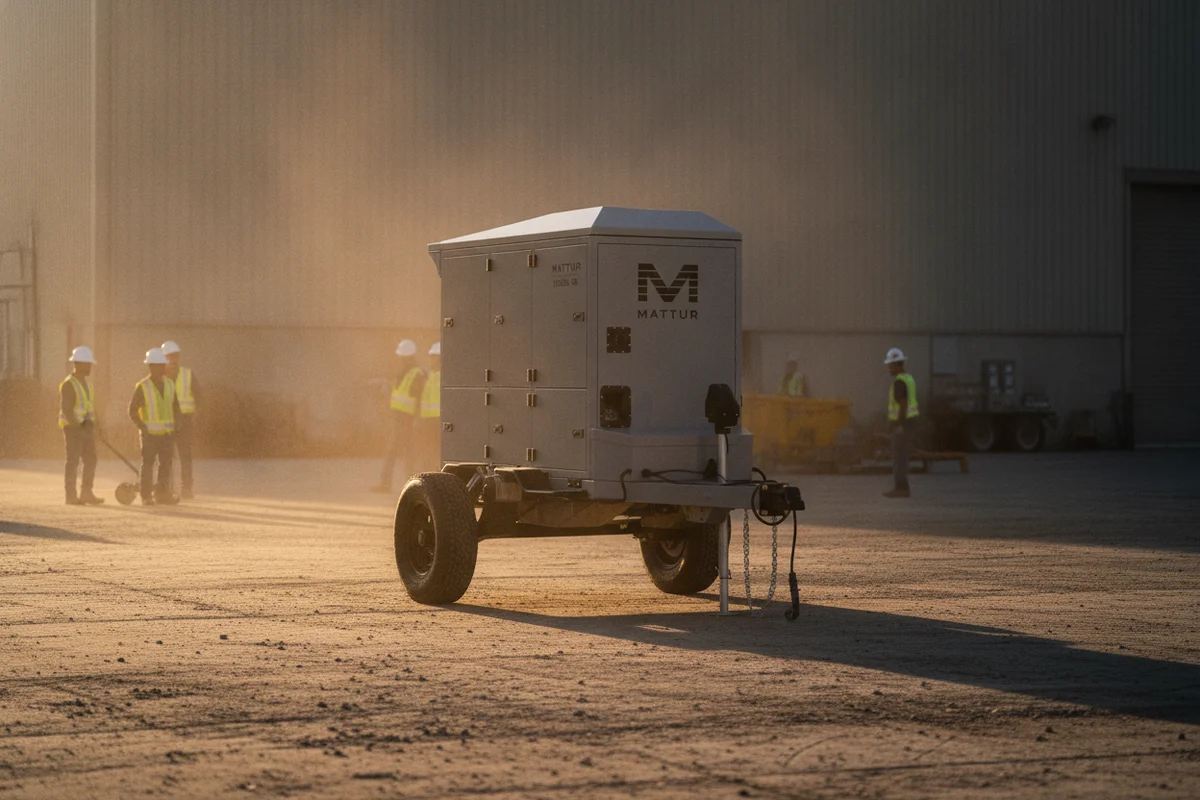
The Edge series is trailer-mounted for rapid deployment and relocation. The Edge 40 covers 40 kW continuous and 72 kW peak. The Edge 80 covers 80 kW continuous and 144 kW peak. Both use the same Meridian Twin engine, the same PulseTech control architecture, and the same parts inventory. A technician trained on the Edge 40 is immediately productive on the Edge 80.
The Power Block series is skid-mounted for fixed installations, defense applications, and stationary industrial deployments where the trailer form factor is not required.
Both form factors share the same core architecture: variable-RPM Meridian Twin engine, supercapacitor bank for 1.8× rated surge capacity, inverter for simultaneous single and three-phase output, and PulseTech for module-level control and parallelization. The supercapacitor bank handles inrush events (motor starts, welding, crane operations) without requiring the engine to be oversized for surge headroom. That is what allows the unit to be right-sized for continuous load rather than peak inrush, which is what produces the fuel efficiency advantage at partial load.
Tier 4 Final compliance is built into the architecture without DEF or SCR after-treatment. No DEF consumable, no cold-weather DEF management, no contamination failure mode. For a rental branch managing a fleet across multiple seasons and climates, that is a meaningful reduction in service complexity.
The 3-year / 3,000-hour warranty and 24-hour factory-direct service response target are the operational backstop. When something goes wrong on a customer site, the branch is not calling a regional distributor and waiting for a parts order. Mattur’s factory-direct service model is designed to match the response time the rental customer expects.
Scaling from One Module to Multi-Unit Arrays
PulseTech enables parallelization of Power Modules into arrays covering 20 kW to 200 kW continuous in standard configurations, and beyond in multi-module deployments. The same module that covers a small jobsite trailer in a single-unit deployment becomes one node in a larger array for a data center commissioning project or a multi-phase construction site.
For the rental branch, this means one SKU covers a range of customer requirements that previously required 4 to 6 distinct generator SKUs across multiple engine families. Parts inventory consolidates. Technician training consolidates. Depreciation curves consolidate.
The fleet management math is straightforward. A branch running 50 Power Modules does not need separate parts bins for three engine families, separate service manuals for four generator lines, or separate technician certification for each platform. The operational drag that comes with a multi-SKU fleet, fragmented parts inventory, retraining costs, and repair downtime is reduced in proportion to how much the branch consolidates onto the Power Module platform.
A branch that converts a portion of its mobile generator fleet to Power Modules starts capturing the SKU consolidation benefit on day one of the first deployment, not at the end of a multi-year transition.
What to Ask Before You Sign a Rental Agreement
Whether you are a rental branch evaluating a new platform or a project manager comparing quotes from multiple branches, these are the questions that surface the real cost of a mobile diesel generator set for rent.
What is the fuel consumption rate at 30 percent load? Not at rated capacity. At the load the site will actually run most of the time. A unit that burns 3.5 gallons per hour at full load but 2.8 gallons per hour at 30 percent load is not the same as a unit that burns 2.2 gallons per hour at 30 percent load. Ask for the partial-load fuel curve, not just the nameplate spec.
Does the unit output single-phase and three-phase simultaneously, or does it require a selector switch? If the site runs both, the answer determines whether you need one unit or two.
What is the surge handling method? If the answer is “the engine is oversized for inrush,” ask what the continuous load rating is relative to the inrush rating. That ratio tells you how much of the engine capacity you are paying to idle.
What is the emissions compliance method? Tier 4 Final with DEF or without. The answer affects consumable management, cold-weather operation, and service complexity over the rental cycle.
What is the service response time if the unit goes down? Factory-direct or distributor chain. The answer affects how long a customer site is without power if something fails.
What does the warranty cover and for how long? A 3-year / 3,000-hour warranty on a rental platform means the branch is not absorbing repair costs during the period when the unit is generating the most rental revenue.
The answers to these questions separate a rental agreement that looks competitive on day rate from one that is actually competitive on total cost over the rental cycle. For the branch manager, they are also the questions that help a customer understand why one unit at a slightly higher day rate produces lower total project cost than a cheaper alternative that burns more fuel and requires more service.
The Rental Economics Come Down to Operating Hours
Every mobile diesel generator set for rent is priced on a day rate. The customer decision, and the branch’s margin, is made on operating hours. A unit that burns 25 percent less fuel at the load profile the site actually runs, handles inrush without oversizing, outputs both phase types simultaneously, and requires fewer service touchpoints over a 90-day rental produces better economics for the customer and better margin for the branch than a unit with a lower day rate and a worse fuel curve.
The Power Module architecture was built around that operating-hours math, not around matching a legacy nameplate spec. For rental branches evaluating whether a new platform is worth the transition cost, that is the starting point for the conversation.
Call 866-MATTUR-1 or visit the Mattur mobile power page to get configuration details and pricing for rental fleet applications.