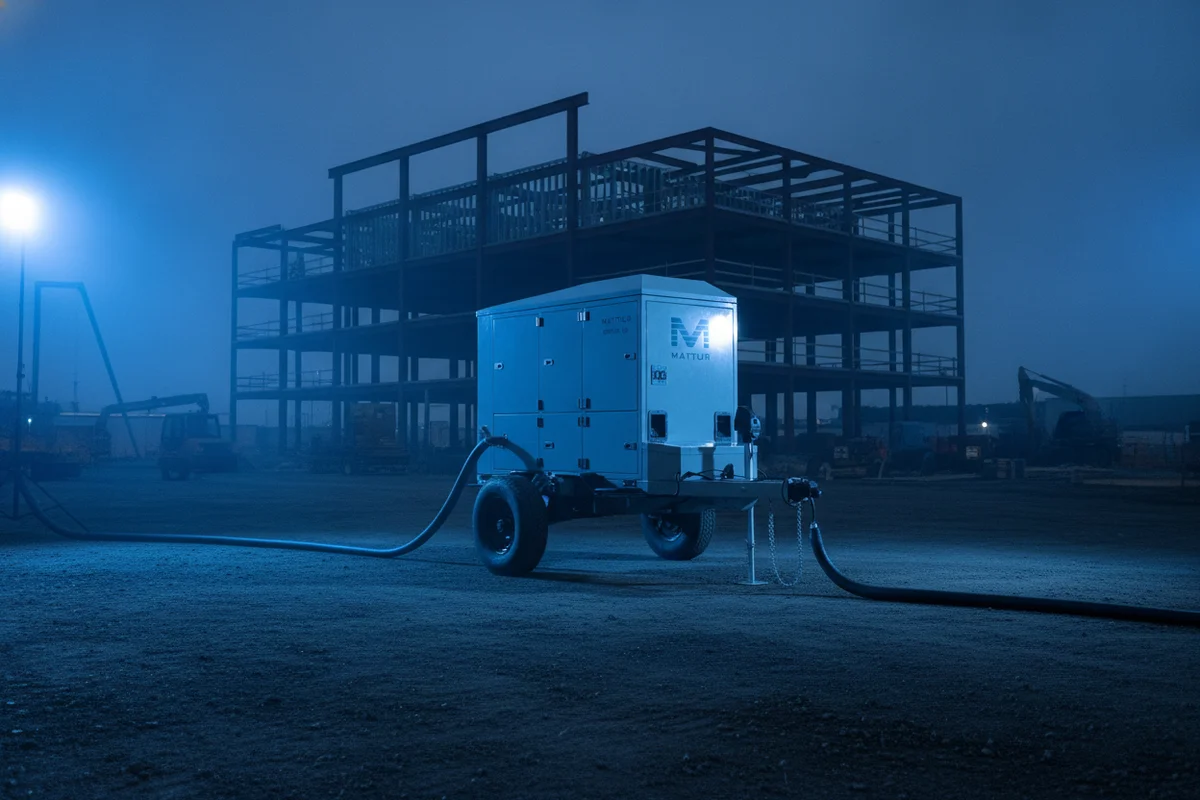
Mobile Diesel Generator Set for Rent | Mattur Power Modules
Rent a mobile diesel generator set that scales from 20 kW to 200 kW on one platform. Mattur Power Modules cut fuel costs 20-30% versus legacy rental units.
Most jobsites do not run at peak load. They run at 30 to 50 percent of rated capacity for the majority of the operating day, with occasional hard starts when motors kick on and brief surges when welding or crane operations spike demand. Legacy mobile diesel generator sets for rent are sized for the peak, which means they idle through the partial-load hours burning fuel at a fixed 1,800 rpm regardless of what the site actually needs. A fleet manager running 50 of those units across active projects is paying for that inefficiency on every invoice.
The Mattur Power Module is a mobile diesel generator set for rent built around a different premise: the engine should follow the load, not the other way around. That single architectural decision, combined with three supporting technologies developed in concert, produces a rental platform that cuts fuel costs 20-30 percent in real jobsite conditions, handles surge events without oversizing, and scales from 20 kW to 200 kW on one SKU. Here is how it works and what it means for your fleet economics.
What One Power Module Delivers Out of the Box
A single Mattur Power Module produces 20 kW continuous output and 36 kW peak output. That covers the majority of small commercial construction sites, remote operations, and event power applications without any additional configuration.
The unit runs on the Meridian Twin engine, Mattur’s proprietary air-cooled engine designed from the ground up for mobile power applications. Air-cooled means no radiator, no coolant system, and no coolant-related failure modes. It also means a smaller physical footprint, which matters when site access is tight or trailer positioning is constrained.
Every Power Module includes a supercapacitor bank rated at 1.8 times the unit’s continuous capacity. That bank handles inrush events, the hard starts that knock legacy gensets offline or force operators to rent oversized units as a buffer. With the supercapacitors absorbing the surge, you size for continuous load and let the architecture handle the peaks.
The inverter produces simultaneous 120/240V single-phase and 208V or 480V three-phase output from one unit. No selector switch. No derating one phase to support the other. The full output is available across both phase configurations at the same time.
Tier 4 Final emissions compliance comes standard, without diesel exhaust fluid or selective catalytic reduction after-treatment. No DEF tank to fill, no DEF contamination failures in cold weather, no SCR system to maintain.
That is the baseline. One unit, one engine family, one parts catalog.
How the Platform Scales From 20 kW to 200 kW
The scaling mechanism is PulseTech, a proprietary control and power architecture that allows multiple Power Modules to operate as a coordinated array. PulseTech is not a bolt-on integration layer. It is built into every Power Module at the hardware and firmware level, which is what makes the array architecture fault-tolerant rather than just additive.
The practical configurations work as follows. The Edge 40 pairs two Power Modules in a single trailer, producing 40 kW continuous and 72 kW peak. The Edge 80 runs four modules in one trailer, producing 80 kW continuous and 144 kW peak. Power Block configurations scale to 200 kW continuous in standard skid-mounted deployments, with multi-array options extending beyond that for large industrial and data center applications.
Every module in an array is independently operable. If one module requires service, it can be swapped without taking the array offline. The remaining modules continue operating at reduced but functional capacity while the replacement is staged. That fault-tolerant characteristic is what separates PulseTech-enabled scaling from a simple parallel genset arrangement, where a single failure typically forces a full system swap.
For a rental fleet manager, the SKU implication is significant. A conventional fleet covering 14 kW to 280 kW of mobile power demand requires four to six distinct generator SKUs across multiple engine families. Each SKU carries its own parts inventory, service documentation, and technician certification requirement. Mattur covers that entire range with one Power Module SKU. One engine. One parts catalog. One training program. Technicians certified on the Edge 40 are immediately productive on the Edge 80 and the Power Block.
Why Variable RPM Cuts Fuel Costs on Real Jobsites
Legacy mobile diesel generator sets run at a fixed 1,800 rpm to maintain 60 Hz output. That fixed speed is mechanically necessary for the alternator to produce grid-frequency power, and it means the engine runs at full throttle whether the site is drawing 10 kW or 70 kW. At 30 percent load, a legacy genset burns roughly 60 to 70 percent of its full-load fuel consumption. The efficiency loss at partial load is a known characteristic of fixed-RPM diesel architecture, and it compounds across every operating hour.
The Meridian Twin engine operates between 1,000 and 4,500 rpm, following actual load demand in real time. The inverter converts the variable-frequency output from the engine into stable 60 Hz power for the site. At 30 percent load, the engine runs at a lower RPM and burns proportionally less fuel. At 80 percent load, it ramps up to meet demand. The engine tracks the work, not a fixed speed target.
In typical jobsite conditions where generators run at 20 to 60 percent of rated capacity for most of the operating day, that variable-RPM architecture delivers 20 to 30 percent lower fuel consumption compared to legacy fixed-RPM units. For a 50-unit rental fleet running at reference construction duty cycles, that fuel reduction compounds to millions of dollars in operating cost over a seven-year fleet cycle.
The DOE’s backup power cost of ownership analysis documents that fuel cost is the dominant variable in mobile and backup power total cost of ownership across extended operating scenarios, including a 176-hour annual runtime scenario used as the longest comparison benchmark. Fuel efficiency is not a secondary consideration. It is the primary lever in fleet economics.
Fuel Savings Calculator
What is your generator really burning?
Enter your current genset's fuel economics and see what Mattur saves you. Real operating burn, not inflated full-load numbers.
Your Current Genset
USD per gallon
Average running time per day
Not sure of your burn?
Most legacy diesel units run at 30 to 50 percent load, where they burn fuel inefficiently.Typical load 50%
Generator size 60 kW
How it works: baseline = fuel cost x gallons per hour x runtime. Annual = baseline x days per week x 52 weeks. Savings range applies a 20 to 30 percent fuel reduction from Mattur's generator technology.
Figures reflect fuel cost only and exclude DEF, maintenance, downtime, and other ownership costs. Estimates for illustration; actuals vary by load, duty cycle, and site conditions.
Single and Three Phase Output From One Rental Unit
Commercial construction jobsites run mixed loads. Three-phase HVAC equipment, elevators, and large motors operate alongside single-phase tools, lighting circuits, and site trailers. A legacy rental genset forces a choice: rent a three-phase unit and add a step-down transformer for single-phase loads, or rent separate units for each phase requirement.
The Mattur Power Module inverter eliminates that choice. It produces simultaneous 120/240V single-phase and 208V or 480V three-phase output from one unit, with no selector switch and no derating. Both phase configurations are available at full rated capacity at the same time.
On a mid-size commercial project running three-phase mechanical equipment and single-phase site power, one Edge 80 replaces what would otherwise require two separate rental units plus transformer hardware. That consolidation reduces the number of units on-site, the number of fuel connections to manage, and the number of service touchpoints per billing cycle.
For a rental operator, it also reduces the number of units required to fulfill a complex project order, which improves fleet utilization and reduces the inventory held in reserve for mixed-phase project requirements.
Comparing Rental TCO Against Legacy Generator Sets
The TCO comparison between Mattur Power Modules and legacy rental gensets operates across three line items: fuel cost, maintenance cost, and fleet management overhead.
Fuel cost is the largest variable. At 20 to 30 percent lower consumption in real jobsite conditions, a 50-unit Power Module fleet at reference construction duty cycles produces approximately $7.5 million in fuel savings over a seven-year fleet cycle compared to an equivalent legacy fleet. That figure is conservative. It holds load flat and Mattur pricing flat across the comparison period.
Maintenance cost is the second variable. The Meridian Twin engine is air-cooled, eliminating coolant system maintenance, coolant replacement intervals, and coolant-related failure modes. Every Power Module ships without DEF or SCR after-treatment, removing DEF tank fills, SCR catalyst replacement, and DEF contamination repairs from the maintenance schedule. The 3-year, 3,000-hour warranty covers the full unit with factory-direct service and a 24-hour response target.
Fleet management overhead is the third variable and the one most often excluded from TCO comparisons. A conventional fleet covering the same power range as a Mattur Power Module fleet requires four to six SKUs across multiple engine families. Each additional SKU adds parts inventory carrying cost, technician training cost, and repair downtime when the right part is not in the right yard. Single-SKU fleet operations reduce all three. At 50 units, the inventory and training consolidation advantage is meaningful. At 250 or 1,000 units, it becomes a material operational differentiator.
Rental operators running 35 to 50 percent gross margins on mobile equipment, consistent with public filings from major national rental companies, capture fuel and maintenance savings directly as margin expansion on existing rental revenue. The economics do not require raising rental rates or changing the customer relationship.
Deployment Configurations for Construction and Industrial Sites
The Power Module ships in two enclosure configurations designed for different deployment contexts.
The Edge series is trailer-mounted. Edge 40 and Edge 80 configurations deploy on standard equipment trailers and can be positioned, repositioned, and relocated with a standard pickup or service truck. Trailer mounting is the right choice for active construction sites where the power source needs to move as the project progresses, for events requiring rapid setup and teardown, and for rental yard operations where units cycle between projects on short notice.
The Power Block series is skid-mounted. Skid mounting is the right choice for fixed industrial deployments, data center construction sites where the power source stays in one location for 18 to 36 months, defense applications requiring a stable platform, and facility backup installations where the unit is positioned once and serviced in place.
Both configurations run the same Power Module, the same engine, and the same PulseTech control architecture. A rental operator carrying both Edge and Power Block inventory maintains one parts catalog and one technician training program across both product lines.
For large industrial projects requiring 200 kW or more, Power Block arrays scale horizontally by adding modules to the array. The same fault-tolerant architecture that applies to a two-module Edge 40 applies to a ten-module Power Block array. Individual modules can be serviced or swapped without taking the full array offline.
How to Rent a Mattur Power Module for Your Project
Mattur sells and rents Power Modules direct, without a dealer intermediary. Factory-direct means the same engineering team that built the unit handles service and support. When a unit needs attention, the response target is 24 hours, and the technician who responds has direct access to the engineering documentation and parts inventory that a third-party dealer service network does not.
The rental process starts with a load assessment. Mattur’s team works through your continuous load requirements, your phase mix, your expected duty cycle, and your site access constraints to identify the right configuration. That assessment determines whether an Edge 40, Edge 80, Power Block, or multi-module array is the right fit for the project.
From there, the unit is configured, tested, and delivered to your site or your rental yard. For fleet operators evaluating a trial deployment, Mattur supports staged introductions that allow a branch to run Power Modules alongside existing inventory before committing to a full fleet transition.
To start an order or discuss fleet pricing, call 866-MATTUR-1 or reach out through the Mattur site. The team can turn around a configuration recommendation and pricing within one business day for standard project requirements.
The Case for a Different Rental Platform
The legacy mobile diesel generator set for rent has been optimized to its ceiling. Fixed-RPM diesel architecture, multi-SKU fleet management, and oversized units running at partial load are not problems that incremental improvements solve. They are characteristics of the architecture itself.
The Mattur Power Module is a different architecture. Variable-RPM engine, supercapacitor surge handling, inverter-driven simultaneous phase output, and PulseTech-enabled fault-tolerant scaling produce a rental platform that cuts fuel costs in the conditions where mobile generators actually operate, covers the full power range from 20 kW to 200 kW on one SKU, and handles mixed-phase jobsite loads without additional hardware.
For a fleet manager running 50 units at reference construction duty cycles, that architecture produces a measurable TCO advantage that holds up under scrutiny. For a rental operator evaluating a new platform, it produces a fleet that is simpler to manage, cheaper to operate, and capable of fulfilling project requirements that a legacy multi-SKU fleet handles awkwardly. The numbers are the argument. Call 866-MATTUR-1 to run them against your fleet.