Utility Scale Battery Energy Storage System Guide
U.S. utility scale battery energy storage system capacity hit 26 GW in 2024. See how Mattur wind pairs with BESS to firm power on 90% of U.S. land.
The U.S. utility scale battery energy storage system market crossed a threshold in 2024 that most developers had penciled in for 2026. Cumulative installed capacity exceeded 26 GW, according to the U.S. Energy Information Administration, with 10.4 GW of new capacity added in a single year. The pipeline for 2025 stands at 19.6 GW of planned additions. Those numbers represent a market that has moved from demonstration phase to infrastructure phase. Site constraints that were manageable at 4 MW of total U.S. installed capacity in 2010 are now material project risks at scale — especially on the wind side of a co-located hybrid, where most project models quietly underperform their pro forma.
The constraint that receives the least attention in BESS project planning is not chemistry, not interconnection queue position, and not ITC eligibility. It is the generation asset paired with the battery. A BESS without a co-located generation source is an arbitrage play. A BESS anchored to a generation asset that cannot reach the site, cannot operate in the available wind class, or cannot fit within the parcel’s dead acreage is a stranded capital problem. The wind component of a wind-plus-storage hybrid is where most of the site-access and site-class risk accumulates, and it is the component that the legacy product line is least equipped to address.
U.S. Utility Scale Battery Storage Capacity in 2024
The EIA’s January 2025 preliminary data confirmed that U.S. battery capacity increased 66% in 2024, reaching 26 GW cumulative. The pace of that growth is not evenly distributed. The first seven months of 2024 alone added 5 GW, with total available capacity reaching 20.7 GW by July before year-end additions pushed the final figure higher.
That growth trajectory reflects a market responding to two simultaneous forces. On the demand side, hyperscaler load commitments and state clean energy mandates are creating a firm clean power requirement that no single generation technology can satisfy on its own. On the supply side, lithium-ion battery costs have fallen far enough that BESS is now the default firming mechanism for new renewable projects rather than an optional add-on.
The 19.6 GW planned for 2025 is the number that should focus developer attention on site selection. A pipeline of that size will stress interconnection queues, transmission capacity, and the land parcels where BESS co-location makes economic sense. Developers who are still treating BESS site selection as a secondary decision after wind or solar siting will find themselves competing for the same constrained parcels.
Why Site Class Limits Legacy Wind Plus Storage
Legacy utility wind turbines require a cut-in wind speed of approximately 3.5 to 4.5 meters per second before they produce useful power. That threshold, combined with the hub heights and rotor diameters needed to reach rated output, restricts economically viable legacy wind development to NREL Wind Classes 4 and above. Wind Class 4 and above covers roughly 10% of contiguous U.S. land area.
The practical consequence for BESS co-location is that the sites where a wind-anchored battery project makes geographic sense are the same sites that every legacy wind developer has already evaluated. Interconnection queues at those sites are long. Land rights are often encumbered. The parcels that remain available in high-wind-class areas tend to be remote, which compounds the logistics problem for BESS skid delivery and ongoing operations and maintenance.
The site-class constraint also interacts with the dead-acreage problem. Legacy turbines require 7 to 10 rotor-diameter spacing in the prevailing wind direction to manage wake losses. On a 2,400-acre site with 170-meter rotors, that spacing leaves substantial land area between turbines that cannot host BESS equipment without violating wake-spacing geometry or triggering setback recalculations. The land is technically within the project boundary but practically unavailable for co-located storage.
A BESS project manager who has worked through an interconnection study knows that the available export capacity at a given point of interconnection is a fixed constraint. Adding BESS to an existing wind site that is already operating near its interconnection limit forces a direct tradeoff between wind repowering and storage expansion. That tradeoff does not exist at a site where the wind component can be deployed at higher density on the same footprint.
How ~2.0 m/s Cut-In Opens 90 Percent of U.S. Land
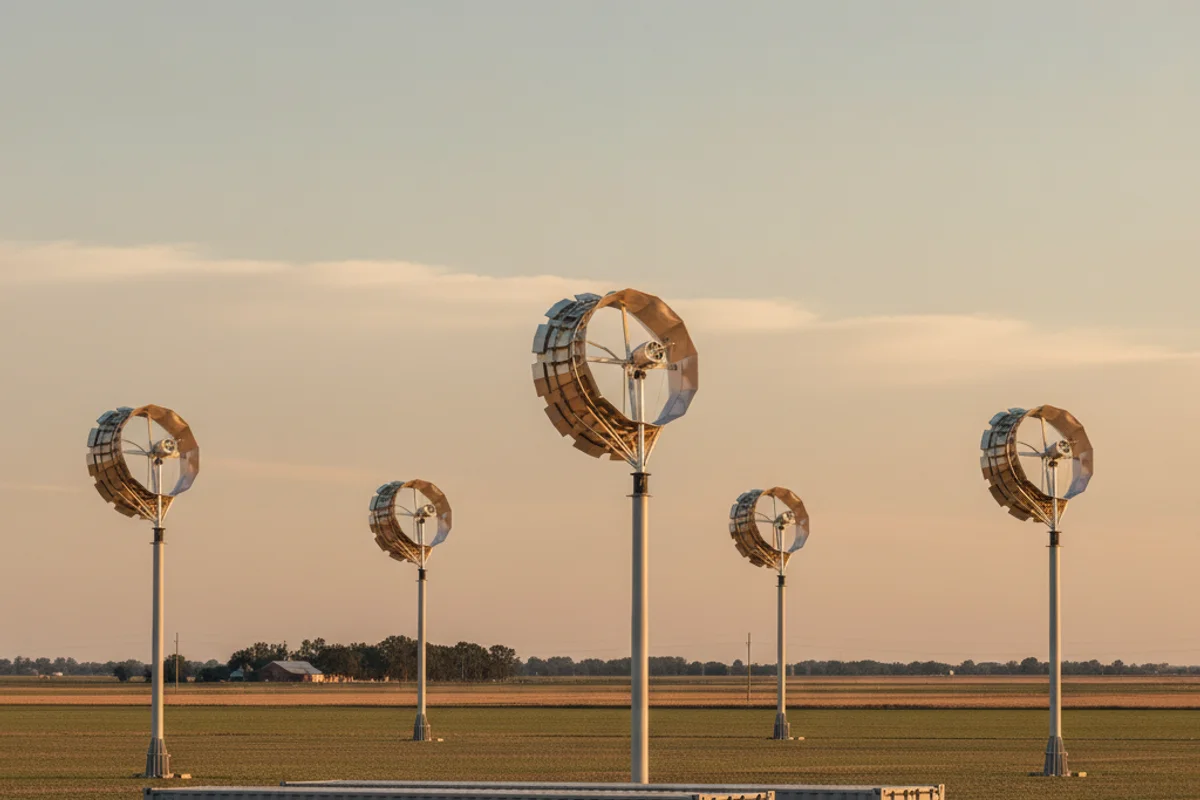
Mattur’s wind turbine cuts in at approximately 2.0 meters per second. That is not a marginal improvement over the legacy threshold. It is a categorical shift in which sites are viable for wind-anchored BESS development.
NREL Wind Classes 1 through 3 cover the majority of U.S. land area, including agricultural regions, industrial buffer zones, and the areas immediately adjacent to load centers where transmission costs are lowest. Legacy utility wind cannot operate economically in those classes. Mattur’s diffuser-augmented design, combined with the PulseTech distributed-coil generator, produces useful power at wind speeds that legacy turbines treat as below the operational floor.
The diffuser shroud accelerates incoming airflow before it reaches the rotor, and the PulseTech generator’s distributed-coil architecture reduces starting torque to the point where that accelerated flow is sufficient to begin power production at ~2.0 m/s. The two subsystems work together. A shroud on a conventional generator still requires the conventional generator’s starting torque to be overcome, which is why earlier diffuser-augmented designs did not achieve the cut-in advantage the aerodynamics suggested they should.
For a BESS project developer, the practical meaning is that viable co-location sites now include parcels that were previously evaluated and rejected because the wind resource was insufficient for legacy turbines. A site in NREL Wind Class 2 with excellent road access, an available interconnection point, and proximity to load is a better BESS co-location candidate than a Class 5 site with constrained access and a three-year interconnection queue. The wind resource constraint has been the reason Class 2 sites were not considered. Mattur removes that constraint.
The 15-meter hub height also matters for site access. Mattur turbines install with standard rigging equipment, not 500-tonne cranes. The oversize-load transport that legacy turbine blades require is not a factor. A site that a BESS developer can reach with standard construction equipment can also host the wind component of the project.
Pairing Mattur Wind With Battery Storage Systems
A wind-anchored BESS project built around Mattur’s modular architecture operates differently from a legacy wind-plus-storage project in three ways that matter to project economics.
First, the wind component can be sized to match the BESS charging profile rather than the interconnection export limit. Legacy turbines come in 2 to 5 MW increments. A developer who needs 7 MW of wind capacity to charge a 4-hour BESS optimally has to choose between 6 MW and 8 MW of legacy wind, accepting either an undercharged battery or an oversized wind plant. Mattur’s 18 kW modules aggregate in 18 kW increments, which allows the wind capacity to be sized to within a fraction of a percent of the target charging load.
Second, the compact rotor geometry allows Mattur turbines to be deployed in the dead acreage between legacy turbine positions on a repower project, or at higher density on a greenfield site. A 100-acre parcel can host 6.5 to 9 MW of Mattur wind capacity alongside co-located solar and BESS equipment. That density is not achievable with legacy turbines on the same parcel.
Third, the modular architecture allows phased deployment. A developer can install the BESS first, begin operations with a partial wind complement, and add wind capacity as project cash flows support it. Legacy turbines require the full crane mobilization and logistics package for each installation event, making phased deployment economically impractical for small increments.
The IRENA utility-scale batteries report notes that utility-scale battery storage systems enable greater penetration of variable renewable energy by storing excess generation and firming output for grid delivery. The wind component’s ability to generate at low wind speeds extends the daily charging window and reduces the number of hours the BESS is drawing from the grid to maintain state of charge.
BESS Economics: Fuel Savings and Frequency Regulation Data
The economic case for utility-scale BESS has been validated across multiple deployment contexts. A 4 MW and 40 MWh U.S. demonstration project documented approximately $2 million in fuel cost savings over its operating period, per IRENA’s analysis. A 27 MWh annual battery production deployment in the UK provided enhanced frequency regulation services that reduced grid operator costs, also per IRENA’s utility-scale batteries report.
Those figures come from early-generation projects at costs that are now substantially lower. The relevant economic question for a developer evaluating a wind-anchored BESS today is not whether BESS pencils out in isolation. It is whether the wind component of the hybrid is adding economic value or consuming project budget without contributing proportionally to revenue.
A wind component that can only operate on Class 4 and above sites forces the project onto high-competition parcels with long interconnection queues and elevated land costs. A wind component that operates on Class 1 through 10 sites allows the developer to select for interconnection availability, land cost, and proximity to load rather than wind resource alone. The site selection flexibility has direct economic value that does not appear in a simple LCOE comparison between wind technologies.
Frequency regulation revenue is also a function of dispatch flexibility. A BESS paired with a wind asset that generates at low wind speeds has more hours of charging opportunity per day, which means more hours of full state of charge available for frequency regulation dispatch. A BESS paired with a wind asset that cuts in at 3.5 m/s has more hours of partial or zero state of charge, which limits the frequency regulation capacity the system can reliably offer.
19.6 GW Planned in 2025: What Developers Need Now
The EIA’s battery storage data shows that U.S. utility-scale battery capacity grew from 4 MW in 2010 to more than 20 GW by mid-2024. The 19.6 GW planned for 2025 represents a pipeline that is larger than the entire cumulative installed base from 2010 through 2023.
That pipeline will not clear without resolution of three structural bottlenecks: interconnection queue delays, site access constraints for co-located generation, and the site-class limitation that concentrates wind-plus-storage development on a small fraction of available U.S. land.
Interconnection queue reform is a regulatory process with a timeline outside any developer’s control. Site access constraints for BESS skid delivery are a logistics problem that can be solved with project design. The site-class limitation is a technology problem, and it has a technology solution.
A developer with a 2025 or 2026 commercial operation date target who is still designing around legacy wind turbine site requirements is building a project on the assumption that the best available parcels will still be available when the interconnection study clears. That assumption is increasingly difficult to defend given the pace of competing filings in every major ISO.
The alternative is to design the wind component of the project around a technology that opens the 90% of U.S. land that legacy wind cannot reach, and then select the site for interconnection availability, land cost, and BESS logistics rather than wind resource class.
Selecting Sites for Wind-Anchored Battery Storage Projects
A site evaluation framework for wind-anchored BESS projects built around Mattur’s architecture differs from the legacy wind-plus-storage framework in the weighting of individual criteria.
Wind resource class drops from a primary constraint to a secondary one. Any site in NREL Wind Classes 1 through 10 is viable for Mattur wind generation. That covers the vast majority of U.S. land area, which means the developer can prioritize interconnection availability, transmission capacity, land cost, and road access without being forced to accept a constrained site because the wind resource is adequate.
Road access becomes more important, not less, when BESS is part of the project. Battery skids are large, heavy, and require staging areas during installation. A site that is accessible with standard construction equipment for both the BESS and the wind component is easier to permit, easier to construct, and easier to maintain than a site that requires oversize-load haul routes for the wind component and standard access for the BESS.
Interconnection headroom at the point of interconnection should be evaluated for the combined wind-plus-storage export profile, not the wind-only or storage-only profile. A site with 10 MW of available interconnection capacity can support a configuration of 6.5 to 9 MW of Mattur wind, co-located solar, and a BESS sized to the export limit, with the battery managing the dispatch profile to stay within the interconnection constraint.
Parcel geometry matters for co-location density. A rectangular parcel with clear access on multiple sides allows Mattur turbines to be distributed across the site without the wake-spacing constraints that govern legacy turbine placement. BESS equipment can be positioned in the same areas where legacy turbines would have required buffer space, using land that would otherwise be unavailable for productive infrastructure.
Existing land rights at aging wind sites deserve specific attention. A site with expiring legacy turbine leases, existing interconnection rights, and transmission access is a repower candidate where Mattur’s modular architecture can increase installed capacity on the existing footprint without re-permitting. The Dry Lake I analysis shows that a site hosting 63 MW of legacy capacity can host 182.48 MW of Mattur capacity on the same 2,400 acres, with no new towers and no expanded site boundary.
The Site-Class Problem Has a Solution
The U.S. utility scale battery energy storage system market is moving faster than the generation assets that anchor it. The 19.6 GW of BESS planned for 2025 will need co-located generation on sites that are accessible, interconnection-available, and economically viable. The legacy wind product line can serve the 10% of U.S. land where wind class is sufficient. The other 90% requires a different architecture.
Mattur’s ~2.0 m/s cut-in speed, 15-meter hub height, and modular scaling model are not features designed for a product brochure. They are the direct response to the site-access and site-class constraints that are limiting where wind-anchored BESS projects can be built. The developer who evaluates sites for interconnection availability and BESS logistics first, and treats wind resource class as a secondary filter, has access to a far larger opportunity set than the developer who is still designing around legacy turbine requirements.
The market has already told developers what it needs. The 26 GW of cumulative BESS capacity installed through 2024 is the demand signal. The question is which wind architecture can meet it across the full range of viable U.S. sites.