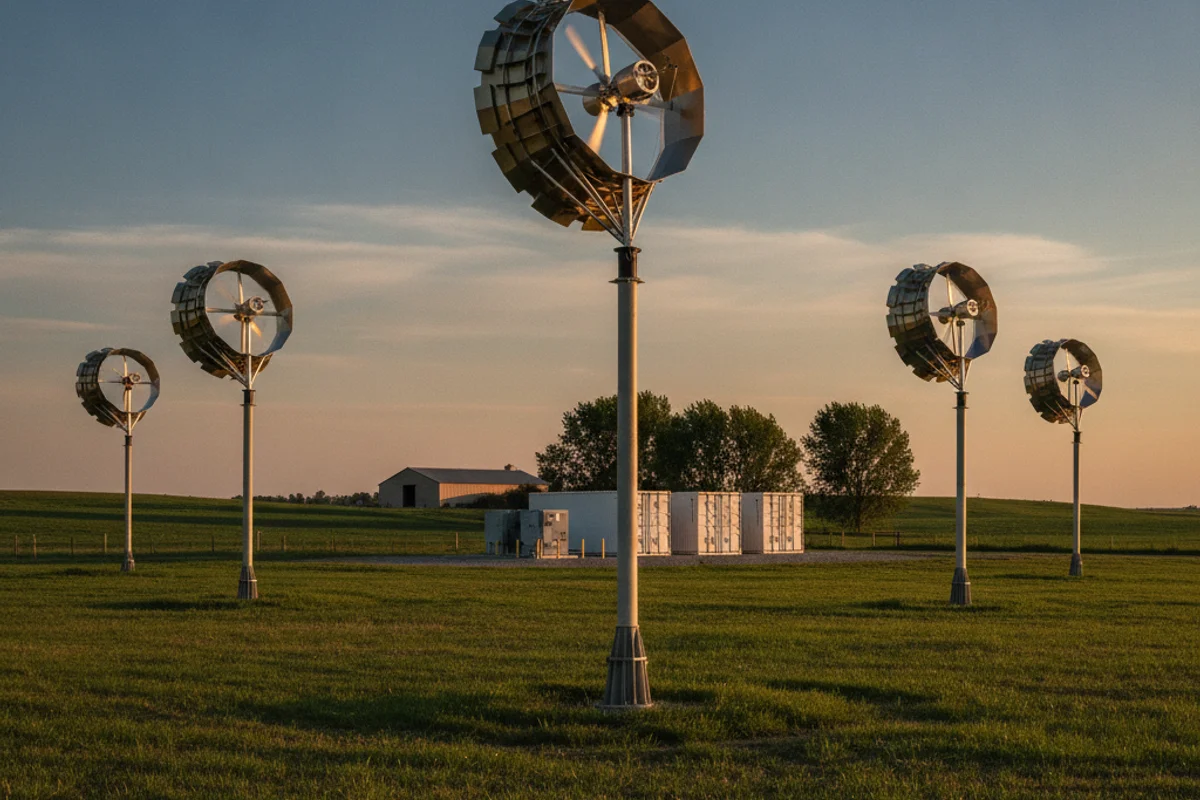
Wind Plus Solar Plus Storage: Firm Power From Low-Wind Sites
Solar-charged batteries go dark at night. See how Mattur Wind cuts in at ~2.0 m/s to firm a wind plus solar plus storage hybrid on low-wind-class U.S. sites.
The utility scale battery energy storage system has become the default firm-power answer for every hybrid renewable project in the United States. The numbers justify the confidence: US cumulative utility-scale battery storage capacity exceeded 26 GW in 2024, up 66 percent in a single year, with 10.4 GW added in 2024 alone and 19.6 GW of additional capacity planned for 2025. Storage is no longer a niche hedge. It is a core generation asset class.
But storage is only as firm as the generation source charging it. A battery that sits at 40 percent state of charge during the evening peak hours is not delivering on its capacity commitment. A battery that cycles primarily on solar and goes dark from sunset to sunrise is not satisfying a hyperscaler’s hourly clean energy matching requirement. The generation side of the hybrid stack is where most project models quietly underperform their pro forma. The wind component is where the gap is largest. What follows is a component-level analysis of how Mattur Wind closes that gap.
US Utility Scale Battery Storage Capacity Hits 26 GW
The growth trajectory of US battery storage is not a forecast. It is an operational fact. From 4 MW of installed capacity in 2010, the US fleet grew to more than 20 GW by mid-2024, with the acceleration compounding each year. The 19.6 GW planned for 2025 additions would nearly double the existing fleet in twelve months.
That growth creates a structural problem that project finance teams are beginning to model explicitly. LCOS for standalone four-hour battery storage runs $170 to $233 per MWh per Lazard’s LCOS analysis. At those figures, storage-heavy configurations are expensive relative to the firm power value they deliver unless the generation source charging them is cheap enough and consistent enough to keep the battery cycling at high utilization. Solar-only charging achieves high utilization during peak irradiance periods and near-zero utilization at night. The battery pays for itself during the day and sits idle when grid prices are often highest.
The math forces a question that most project models defer: what generation source charges the battery when solar cannot?
Why Storage Without Wind Leaves Revenue on the Table
Hyperscaler offtake agreements have moved from annual clean energy matching to hourly matching. Google’s 24x7 Carbon-Free Energy commitment, Microsoft’s power purchase structure with AES, and similar frameworks from AWS and Meta all require that clean generation match load on an hour-by-hour basis. A solar-plus-storage system that delivers clean power from 7 AM to 9 PM and draws from storage overnight is not satisfying that requirement during the hours when storage is depleted.
Wind generation has a fundamentally different production profile than solar. Wind output peaks during evening and overnight hours across most US regions, which is precisely when solar output is zero and grid prices are highest. A co-located wind asset that generates during those hours keeps storage charge levels higher, reduces the number of hours the system falls short of its firm capacity commitment, and improves the effective capacity factor of the combined system.
The catch has always been that legacy utility wind turbines require NREL Wind Class 4 or higher to operate economically, restricting viable co-location sites to roughly 10 percent of US land area. The sites where solar economics are strongest, the Southwest and the southern Great Plains, tend to be Wind Class 1 through 3. Legacy wind and utility solar have been pointing at different maps, which is why solar-plus-storage became the default hybrid configuration rather than wind-plus-solar-plus-storage.
Mattur Wind is built to close that site mismatch. The architecture starts with the generator.
PulseTech Generators Cut In at Approximately 2.0 Meters Per Second
The cut-in wind speed of a turbine is the minimum wind speed at which the generator produces useful power. For legacy utility turbines, that figure runs 3.5 to 4.5 m/s. Below that threshold, the generator’s starting torque exceeds the aerodynamic force the rotor can produce, and the unit sits idle.
Mattur’s PulseTech generator replaces the single large generator that defines every legacy turbine with a distributed network of micro-generators. Each micro-generator is optimized for a narrow, efficient RPM band. As rotor speed increases with wind speed, additional micro-generators engage sequentially. The system approaches peak conversion efficiency across the full wind range rather than at a single rated point.
The distributed architecture also dramatically reduces starting torque. With lower starting torque, the rotor begins turning and producing power at approximately 2.0 m/s. That is not a marginal improvement over the 3.5 m/s legacy floor. Because wind power scales with the cube of wind speed, the difference between 2.0 m/s and 3.5 m/s represents a substantial expansion in the number of hours per year the turbine is generating. Across NREL Wind Class 1 through 3 sites, that cut-in advantage is the difference between a viable wind asset and a unit that sits idle for a significant fraction of the year.
For a hybrid project developer, the practical consequence is that Mattur Wind can be co-located on the same site as the solar array rather than on a separate high-wind site connected by additional transmission. One interconnection point. One substation. One transmission upgrade shared across both generation assets.
PulseTech is also the manufacturing thread that ties the wind product to Mattur’s Mobile and Backup product lines. Generator development amortizes across three product lines simultaneously, which drives the cost curve down faster than any wind-only competitor can match on a single-product platform.
The Diffuser Shroud Triples Available Rotor Energy
The PulseTech generator solves the starting torque problem. The diffuser shroud solves the energy density problem.
A cone-shaped shroud surrounds the rotor and creates a pressure differential that accelerates incoming airflow by up to 1.5x before it reaches the blades. Wind power scales with the cube of wind speed. A 1.5x increase in effective wind speed translates to roughly 3.4x the energy available at the rotor. That multiplication is what allows a 5-meter Mattur rotor to achieve approximately 700 W/m² power density, compared to 200 to 350 W/m² for typical large onshore turbines.
The shroud is not a new concept. Diffuser-augmented wind turbines have been attempted commercially before, with FloDesign and SheerWind as the most prominent examples. Both built a shroud around an otherwise conventional generator and ran into the same problem: the shroud delivered the expected aerodynamic acceleration, but the conventional generator’s starting torque consumed the gain before useful power was produced. The shroud is the aerodynamic solution. The PulseTech generator is the electrical solution. Mattur integrates both in a single platform, which is the combination that prior DAWT attempts did not achieve.
The power density advantage has direct consequences for hybrid project economics. On a 100-acre parcel, Mattur’s compact rotor and diffuser-driven flow allow approximately 2.90x the installed wind capacity per acre compared to legacy onshore turbines with their required wake spacing. That same 100 acres can host 6.5 to 9 MW of Mattur wind alongside 15 to 20 MW of partner solar, all behind a single interconnection. For a developer optimizing generation output per interconnection point, which is the core constraint in most active US markets, the density advantage is a direct improvement to project IRR.
The diffuser shroud also enables the 15-meter hub height that keeps Mattur below FAA aviation review thresholds and outside most local setback ordinances. Legacy utility turbines at 80 to 120 meter hub heights trigger FAA review, community opposition, and permitting timelines that run four to eight years from interconnection request to commercial operation. A 15-meter hub installs in months.
Intelligent Inverter Handles DC Coupling Without Conversion Loss
Every energy conversion step in a hybrid system costs efficiency. A wind turbine that produces AC power, feeds it through a rectifier to DC, then passes it to a battery inverter for storage, and finally through another inverter for grid dispatch loses a measurable percentage of generation at each conversion stage. In a system designed to maximize every megawatt-hour of wind output, those losses compound over a 25-year asset life.
Mattur’s intelligent inverter manages real-time maximum power point tracking across the distributed PulseTech coils and handles DC-coupled handoff directly to co-located storage. The wind-to-storage path bypasses the intermediate AC conversion step that adds losses in AC-coupled configurations. For a developer modeling a wind-plus-solar-plus-storage hybrid on a single interconnection, the DC coupling architecture is an efficiency gain that improves the effective capacity factor of the storage asset.
The inverter also handles grid synchronization and anti-islanding for grid-tied deployments and manages reactive power at the unit level. That means one set of switchgear and one substation can serve both the wind and solar generation assets and the storage system, rather than requiring separate power electronics for each generation source.
Over-the-air optimization updates from the Adaptix AI fleet layer reach each unit through the inverter, which means the power extraction strategy for every deployed turbine can be updated as the fleet learns from operational data. The inverter is not a static component. It is the hardware interface through which the software layer improves system performance over time.
Adaptix AI Dispatches Wind Output to Match Storage Cycles
A battery storage system has a finite number of cycles over its design life. Charging and discharging at the wrong times, or at the wrong rate, degrades the battery faster and reduces the economic life of the asset. A wind source that dumps power into storage indiscriminately, without regard for the battery’s state of charge or the grid’s price signal, is not optimizing the combined system.
Adaptix AI is Mattur’s fleet-wide optimization layer. It receives live wind data and performance telemetry from every deployed unit and continuously refines the power extraction strategy for each turbine. For hybrid deployments, Adaptix coordinates wind dispatch with storage charge cycles and grid price signals, directing wind output toward storage when prices are low and toward direct grid export when prices are high.
The fleet learning architecture means that every additional Mattur unit deployed improves the performance of every existing unit through shared performance data. A fleet of 500 units operating across multiple sites generates more optimization signal than a fleet of 50. The performance advantage compounds as the fleet grows, which is the inverse of the legacy turbine model where component wear degrades output year over year.
IRENA’s utility-scale battery analysis documents that storage systems providing enhanced frequency regulation and dispatch optimization deliver meaningfully higher value than storage operated as a simple peak-shaving buffer. Adaptix is designed to capture that value by treating wind dispatch and storage cycles as a single optimized system rather than two independent assets sharing a wire.
That single-system view is the entire Mattur architecture in one picture: proprietary wind paired with partner solar to generate the lowest-cost electricity, battery or hydrogen storage holding the surplus for 24/7 reliability, and Adaptix AI directing every handoff to the high-demand sectors that pay the most for firm power.
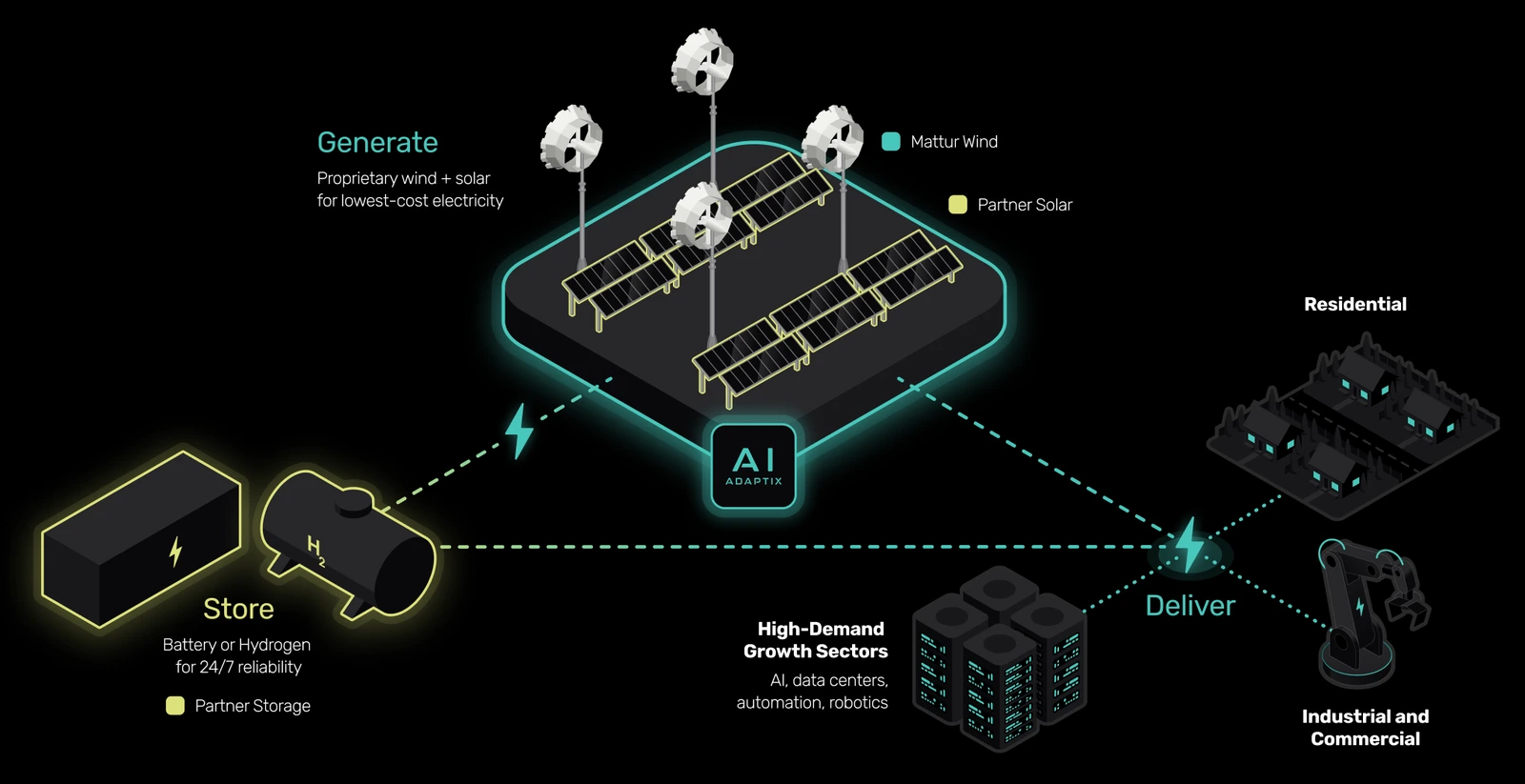 Generate, store, deliver: Mattur Wind and partner solar generation, battery or hydrogen storage, and Adaptix AI dispatch — one coordinated system feeding data centers, industrial and commercial, and residential load.
Mattur Wind Plus Storage Beats Gas Combined Cycle on LCOE
The blended LCOE argument for Mattur-anchored hybrid projects is not a marketing claim. It is a capacity-weighted calculation using Lazard’s LCOE+ (June 2025) midpoints as the component benchmarks.
Mattur Wind’s starting LCOE on qualifying sites runs from $16/MWh and up, depending on site wind class and project configuration. Legacy onshore wind runs $37 to $86/MWh per Lazard, with a midpoint around $61/MWh. Utility solar PV runs $38 to $78/MWh, midpoint around $58/MWh. Standalone four-hour battery storage LCOS runs $170 to $233/MWh.
In a balanced hybrid configuration (45 percent wind, 35 percent solar, 20 percent storage), the capacity-weighted blended LCOE for a Mattur-anchored system runs approximately $79/MWh at midpoint component costs. The same configuration with legacy wind in the wind slot runs approximately $94/MWh. The difference is the wind component contribution: roughly $12/MWh for Mattur versus $27/MWh for legacy wind in that configuration.
New gas combined cycle runs $48 to $109/MWh per Lazard, with a midpoint around $79/MWh. A Mattur-anchored hybrid at $79/MWh blended LCOE matches the gas combined cycle midpoint while delivering firm clean power that satisfies hourly clean energy matching requirements. Legacy-wind-anchored hybrids at $94/MWh do not match gas on cost and carry the additional constraint of being restricted to Wind Class 4 or higher sites.
The cost advantage is structural rather than cyclical. It compounds through three mechanisms: standard industrial component supply chains that do not require bespoke aerospace-grade blade fabrication, no specialized installation equipment (no 500-tonne cranes, no oversize-load blade transport), and PulseTech generator development amortized across three product lines simultaneously. As manufacturing volume scales, the cost curve bends down faster than any wind-only competitor can match.
For a developer evaluating generation and storage technology stacks for a 2028 or 2029 commercial operation date, the practical question is not whether the LCOE math holds. It is whether the wind component can actually perform at the modeled capacity factor across Wind Classes 1 through 3. Mattur’s field validation at the Tonopah, Arizona facility, operating in conditions where conventional turbines cannot generate at all, is the operational answer to that question. The 700 W/m² power density, approximately 2.0 m/s cut-in, and 18 kW rated output are figures from operating hardware, not computational fluid dynamics simulations.
What This Means for Your Project Stack
The utility scale battery energy storage system build-out now underway in the United States is the largest grid infrastructure investment in a generation. The 19.6 GW planned for 2025 additions will require generation partners that can actually keep those batteries charged across the full 24-hour cycle, not just during peak solar hours.
The generation component that closes the gap between solar-only charging and firm clean power is wind. The wind component that makes hybrid co-location economically viable across the sites where solar economics are strongest is a turbine that operates at approximately 2.0 m/s cut-in, achieves 700 W/m² power density on a compact footprint, couples directly to storage without intermediate conversion losses, and dispatches through a software layer that treats wind and storage as a single optimized system.
That is what Mattur Wind is built to do. The engineering moat is not any single component. It is the system that results when PulseTech generators, the diffuser shroud, the intelligent inverter, and Adaptix AI are designed from the start to work together on the same platform. Contact Mattur for a site assessment and blended LCOE model for your project.